
In previous posts I explained how EMC leverages an analytic process to manage university research globally.
Truth be told, the analytic process actually measures global innovation;
university research is a subset of corporate innovation activities. The context of university research is worth
exploring on its own, however, and I took the opportunity to share our approach
with partner faculty and students at EMC’s 2nd Annual University
Day.
Analyzing university research side-by-side with other
corporate innovation activities has its advantages. In my last post, I shared
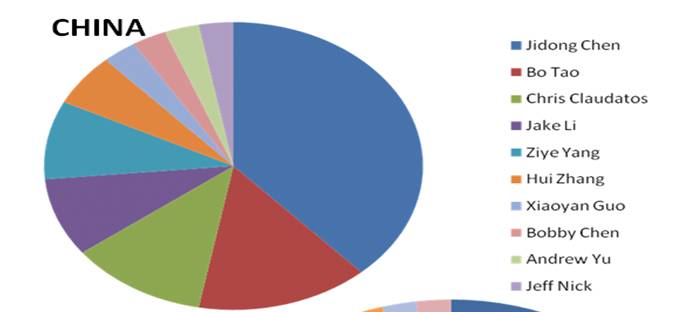
specific data about a list of Chinese researchers that are actively involved in
local university research. The pie chart
below highlights the set of researchers that collaborated with Chinese
universities for a specific time period.
In addition to participating in local university research,
the engineers at EMC Labs China are also actively involved in the yearly EMC
idea contest known as the Innovation Roadmap. Historical idea submissions from
global employees (8,000+ ideas and growing) are also stored in this innovation
database.
Employees are encouraged to submit their ideas as “teams”.
In fact, diversity of team members, whether it be geographic or by function, is
highly encouraged. This diversity is a leading cause of
increased idea quality, as I’ve discussed in a recent post. As a result of storing many years’ worth of
historical idea submissions, we can begin to visualize team submissions using
social network analysis. For example,
the social graph below focuses on Chinese employees that continually surface as
“strong collaborators” in the area of idea submission.
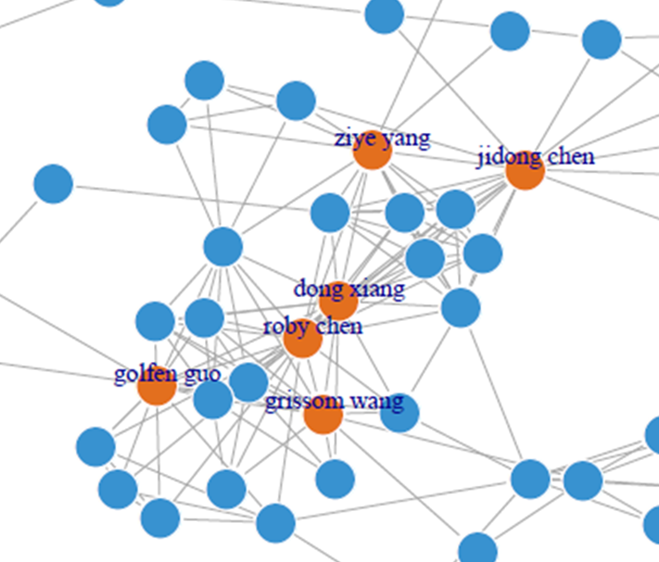
In the graph above it is apparent that Jidong Chen, for example, has
a network of collaborators with which he submits ideas. Chances are good that
Jidong, during discussions with his peers, is sharing the work of his
university counterparts either directly or indirectly.
A more important question, in my mind, is whether Jidong is
sharing knowledge across boundaries. These boundaries could be
geographic, they could be technology related (e.g. security researchers, compression researchers,
etc), or they could be by function (collaborating with marketing, HR, finance, etc).
In order to validate that any given EMC employee is indeed
crossing boundaries in the transfer of university research knowledge, the
analysis was run again with color-coded values representing country of origin.
The graph below is a zoomed-out picture of the same chart, with color coding of
each individual by geography.
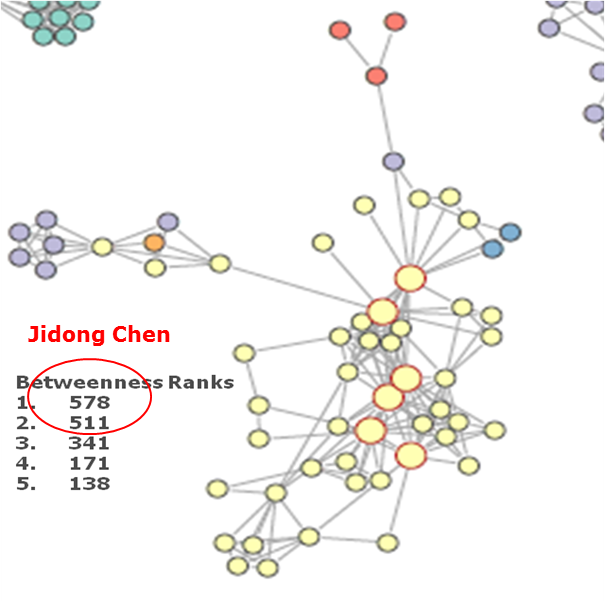
The yellow dots represent Chinese employees. The yellow
circles with red boundaries correspond to the red circles in the previous
chart. One can readily see that Chinese idea submitters not only cluster
together, but they bridge to other geographies as well. The colors of
these circles represent employees in France, Israel, Australia, and the United
States. As a result, certain Chinese
employees have extremely high betweenness ranks, which means that they are
strong candidates to transfer their knowledge to other countries.
Whether or not they actually DO transfer that knowledge is a
different thing altogether. Is it enough to know that the potential is
there? The answer is no. However, the knowledge of betweenness allows a
centralized innovation program to guide good behaviors when it comes to global
knowledge transfer. The analytic results give us all the pieces to put a plan
into action.
This post has highlighted the ability to explore
connectedness and collaboration emanating from an EMC employee
conducting local university research. Knowledge expands locally, and then it has the potential to be transferred globally.
What about the reverse of this process? Can any global
researcher correlate their research efforts to a remote employee like Jidong?
In a future post I will examine analytic techniques to
enable this behavior.
Steve
EMC Fellow