

Miami is becoming the Tech Beach of the industry!
Today I am speaking at the eMerge Americas 2016 Conference in Miami, FL. The conference focuses on innovation in high-tech, and I was asked to introduce the topic of Data Value. My goal is for the companies in attendance to become familiar with emerging data valuation business processes and share five “getting started” ideas with them.
My company (EMC) picked up on data value several years ago and kicked off an Architecting For Data Value research project with Dr. Jim Short of the San Diego Supercomputer Center (Dr. Short hosted a first-in-kind data valuation workshop this past January).
In previous blog posts I have introduced some of the emerging data valuation business processes that Dr. Short has discovered in the industry, including:
These use cases establish the importance of data valuation, but the research is showing that few if any companies have formal data valuation processes in place. At the conference today, I’m using the chart below as a “getting started” guide that has strong affinity with another body of research: the Information Generation.
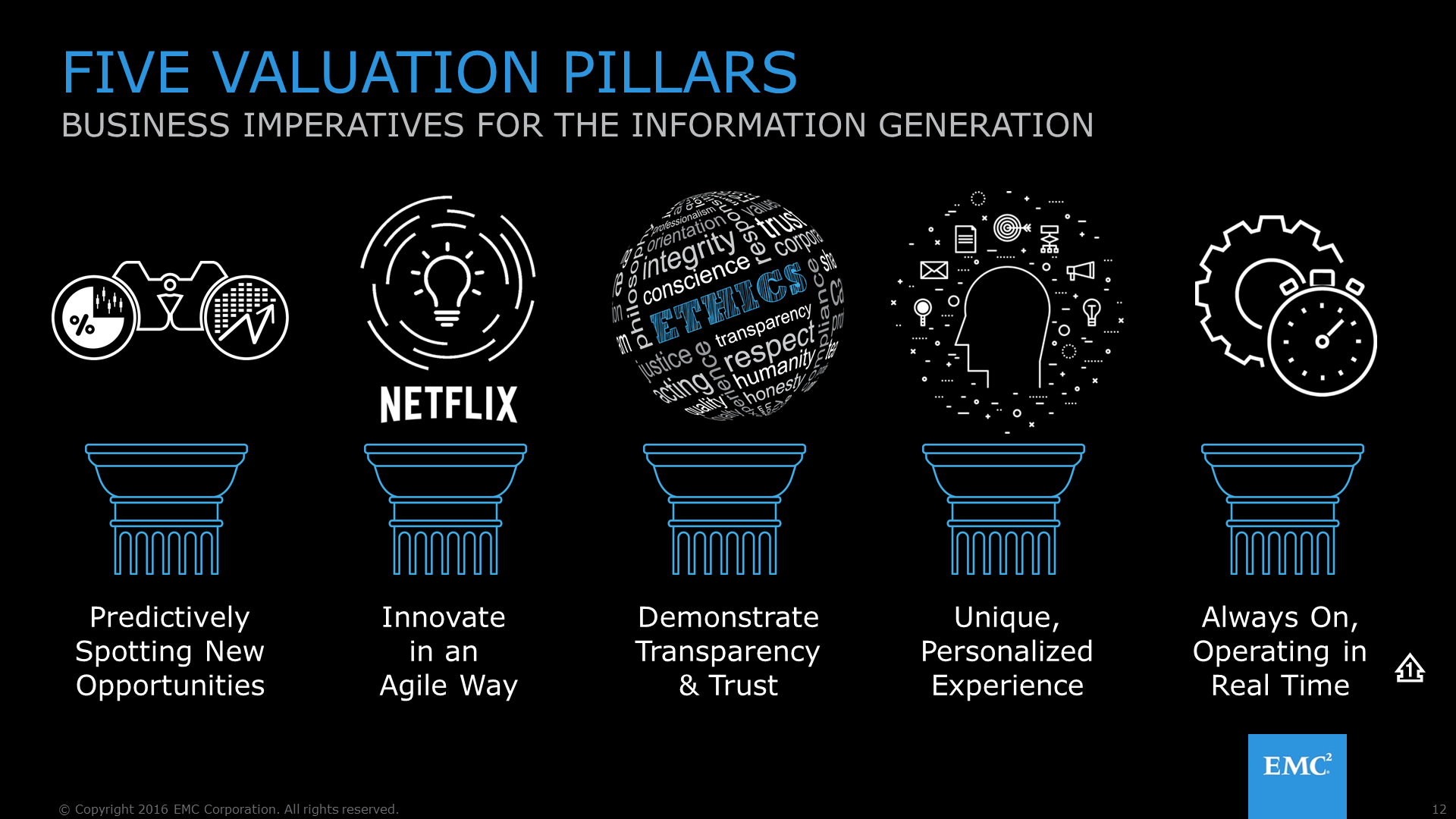
My recommendations for these five pillars are described below.
Predictively Spot New Opportunities via a Data Analytic Lifecycle
In order to extract the most value out of data, companies must launch data initiatives that (a) uncover new sources of revenue, and/or (b) uncover new opportunities to cut expenses. This requires a disciplined approach to data analytics which is often referred to as the Data Analytic Lifecycle.
I’ve documented data analytic lifecycle best practices in previous blog posts. Companies interested in data valuation would do well to receive training on the topic and standardize their analytic processes.
The faster a company completes the lifecycle, the more value will be realized from the data. The lifecycle therefore has a strong affiliation with the analytic capabilities of the underlying infrastructure (e.g. a Data Lake).
Innovate in an Agile Way via Application Deployment Agility
One of the more critical aspects of succeeding as a digital business is to drastically reduce the amount of time it takes to take create brand new applications (or patch/rev existing ones). Gartner estimates that in less than five years 75% of companies will “build” rather than “buy” their applications. Netflix is an example of a company that can come up with a new idea and have it running in production in a matter of hours (often referred to as Global Continuous Delivery).
Newer applications with newer features generate fresh data with higher value. Companies that wish to capitalize on this imperative must embrace agile programming tools and processes.
Demonstrate Transparency and Trust of Data via a Data Ethic
Consumers in the future will begin to understand the value of their own data and begin to care more deeply about the reputation of the provider that curates their data. This high-value data may not only bring positive value to the provider but also negative value in terms of regulatory fines and penalties for non-compliance to data privacy laws. There are two approaches providers are using to curate consumer data more effectively:
- Streaming classification on ingest: classify the content on ingest and steer it towards the appropriate protection tier.
- Value-appropriate data protection: the amount of data protection applied to incoming data is related to its value (e.g. does it contain highly regulated content)
Companies that provide accurate classification and data protection of data assets reduce their risk and thus reduce the potential negative valuation that sensitive data often brings.
Unique Personalized Experiences via Compelling User Interfaces
Every company will need a strong User Experience (UX) team. As more and more companies generate their own applications, they need to ensure that consumers of those applications have an agreeable experience interfacing with the application. This means that companies will often be displaying their application on mobile devices and/or small tablets. Without an expert UX team that knows how to “thrill” consumers with state-of-the-art interfaces, these consumers will send their valuable data to another provider.
One of the best ways to get started building such a team is to send employees to a pair-wise programming workshop that specializes in developing applications for small form-factor mobile devices and tablets.
Always On, Operating in Real Time via a Data Lake Architecture
I have already mentioned that the value of data cannot be fully leveraged without a full understanding of the data analytic life cycle. This lifecycle is a process that needs an agile infrastructure underneath. The state of the art for analytic infrastructure is known as a Data Lake. In order to quickly move through the analytic lifecycle, the underlying Data Lake must support the ability to quickly create analytic sandboxes, run analytic models, and create compelling visualizations.
Corporations that store their data in the cloud may not have full access to the rich set of analytic tools that are common in a Data Lake. For this reason they end up building their own (cloud-like) version of a data lake (or shop for a provider that has one).
These five pillars, when deployed together, form the basic foundation for implementing data valuation business processes. If your company is a startup or only a few years old, you’re in an advantageous position: you may not have to deal with the tech debt/outdated modes of operation experienced by many established companies. You may not have to transform an existing business to compete in this digital era. You are born into it. You can build your business the right way.
Established companies will need to undergo some sort of transformation (e.g. making data-savvy products or offering data-intensive online services). I have previously posted some suggestions to help these companies journey to data value.
Either way, the best company to help start the journey to be a software-driven company is Pivotal.
In future posts I will continue to dive down into further insights arising from Dr. Short’s research.
The full video of my session can be found here.
Steve
Twitter: @SteveTodd
EMC Fellow