
In a previous post I introduced two key “things to know” about the formation of DELL Technologies:
- Decades of experience between EMC and Dell will result in economic benefits to customers.
- Dell Technologies will enable customers to innovate in the face of digital disruption.
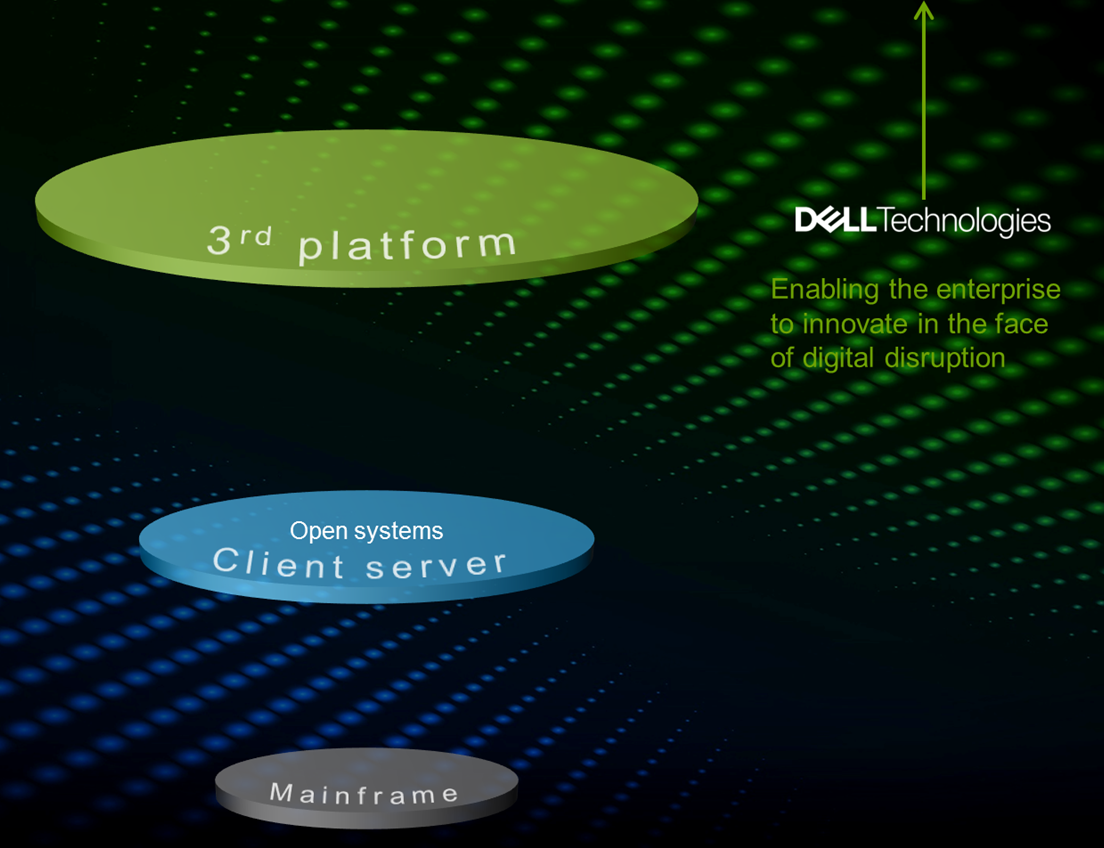
Item #1 is primarily referring to infrastructure. Dell Technologies is uniquely positioned to drive infrastructure efficiency and reduce infrastructure costs because both companies have decades of infrastructure expertise to offer the industry. I explained this positioning in the context of each company’s historical starting point by using the diagram below:
Item #2 is about data. Dell Technologies has all the pieces to create a data platform for innovation (referred to by analysts as a Digital Business Platform, or DBP).
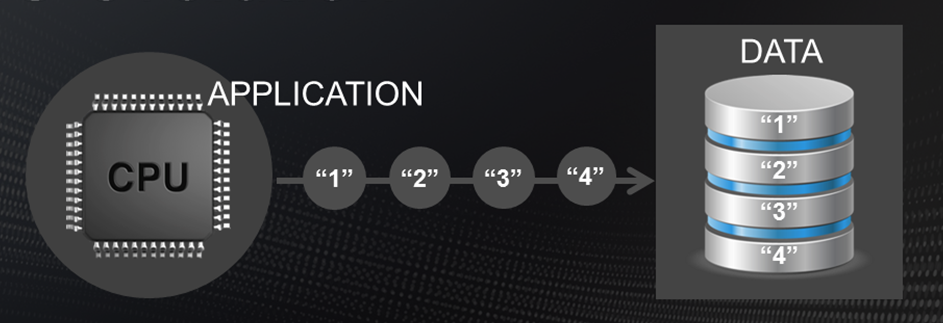
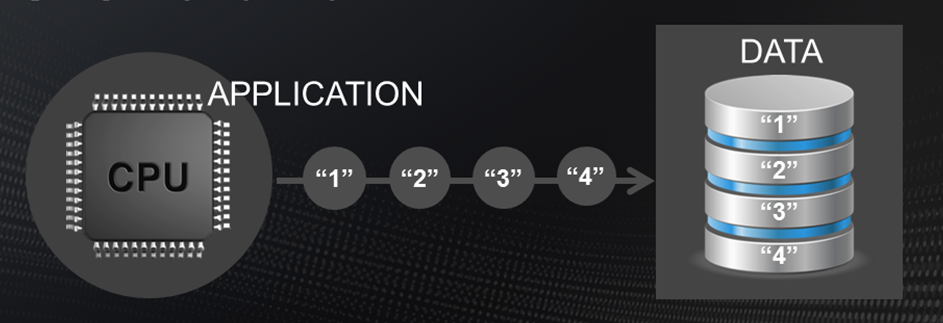
In between the CPU on the left and the physical disk on the right we see the flow of data. Thirty years ago, this data was confined to one disk. During the CLIENT/SERVER ERA, application data began to geographically sprawl in a many-to-many manner:
- Many applications,
- running in many geographic locations,
- began to access many different copies of data,
- that were also located in many different geographies.
The evolution of this reality is depicted below.
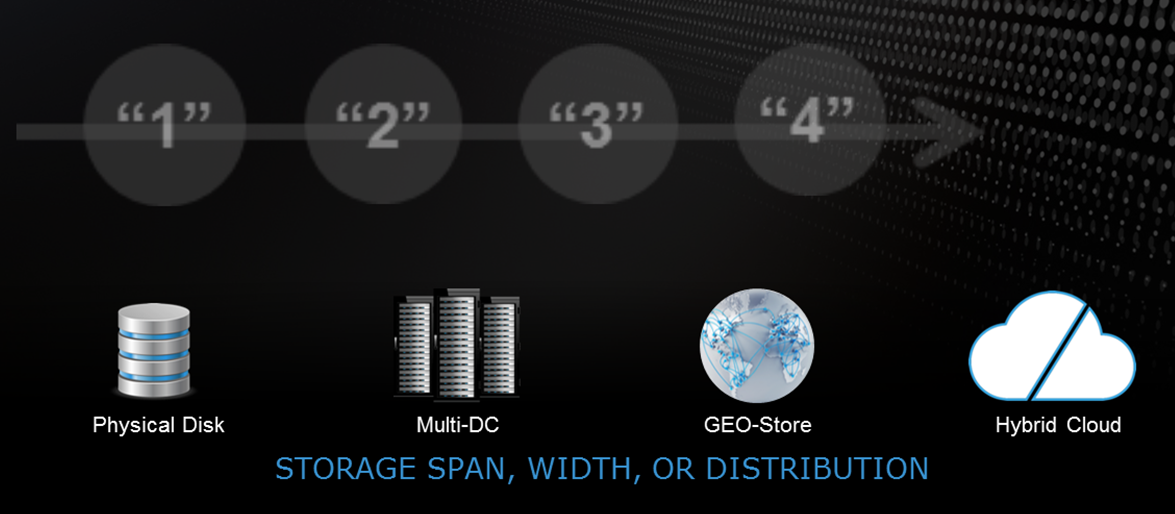
Data was confined to one physical disk. It soon spread to multiple data centers (e.g. via disaster recovery techniques). The industry then began to see singular data pools that could run on different continents (e.g. ECS). And finally, companies began to expand their data to public cloud environments (resulting in a hybrid cloud experience).
In a world where every company must begin treating their data as a capital asset, the geographical distribution of data, and the ability to process it and drive immediate business decisions, has become one of the biggest business challenges of the 21st century. By joining forces, DELL Technologies has a unique opportunity to assist companies as they navigate this “digital disruption”.
Here’s why I think DELL Technologies is well-positioned to assist the industry in leveraging data as an asset to drive immediate business decisions.
The company is organized into two functional areas: DELL Client and DELL EMC.
You can think of DELL Client as a portfolio of endpoint technologies with direct access to the most important part of the business ecosystem: people. DELL Client also has a portfolio of endpoint technologies that provides access to the fastest growing part of the business ecosystem: things. These endpoint technologies provide capabilities for data collection from things and control of things.Together the new company will provide infrastructure access to the Internet of Things and People (IoT&P). Once this access is in place, a channel is available for turning business decisions into programmatic action that flows towards things and people. DELL Client enables actions after decisions.
You can think of DELL EMC as a portfolio of cloud infrastructure technologies that creates digital platforms that drive decisions based on data. It combines all of the components of the entire stack (described previously here), packages them into converged offerings, and installs software-based business solutions on top of them. These converged offerings and software-based solutions can be deployed as a centralized cloud (in a data center) or as a distributed cloud near the edge (the latter is also referred to as Edge Computing or Fog Computing).
Last week DELL’s Jeff Clarke summarized very well the important interplay between DELL Client and DELL EMC. He points out that some of the products that traditionally fell into the EMC side of the house (e.g. Airwatch) are now part of DELL. The same is true for DELL products that have moved over into the DELL EMC portfolio (in future posts I plan to dive down into the contributions that each company is making into these two buckets):
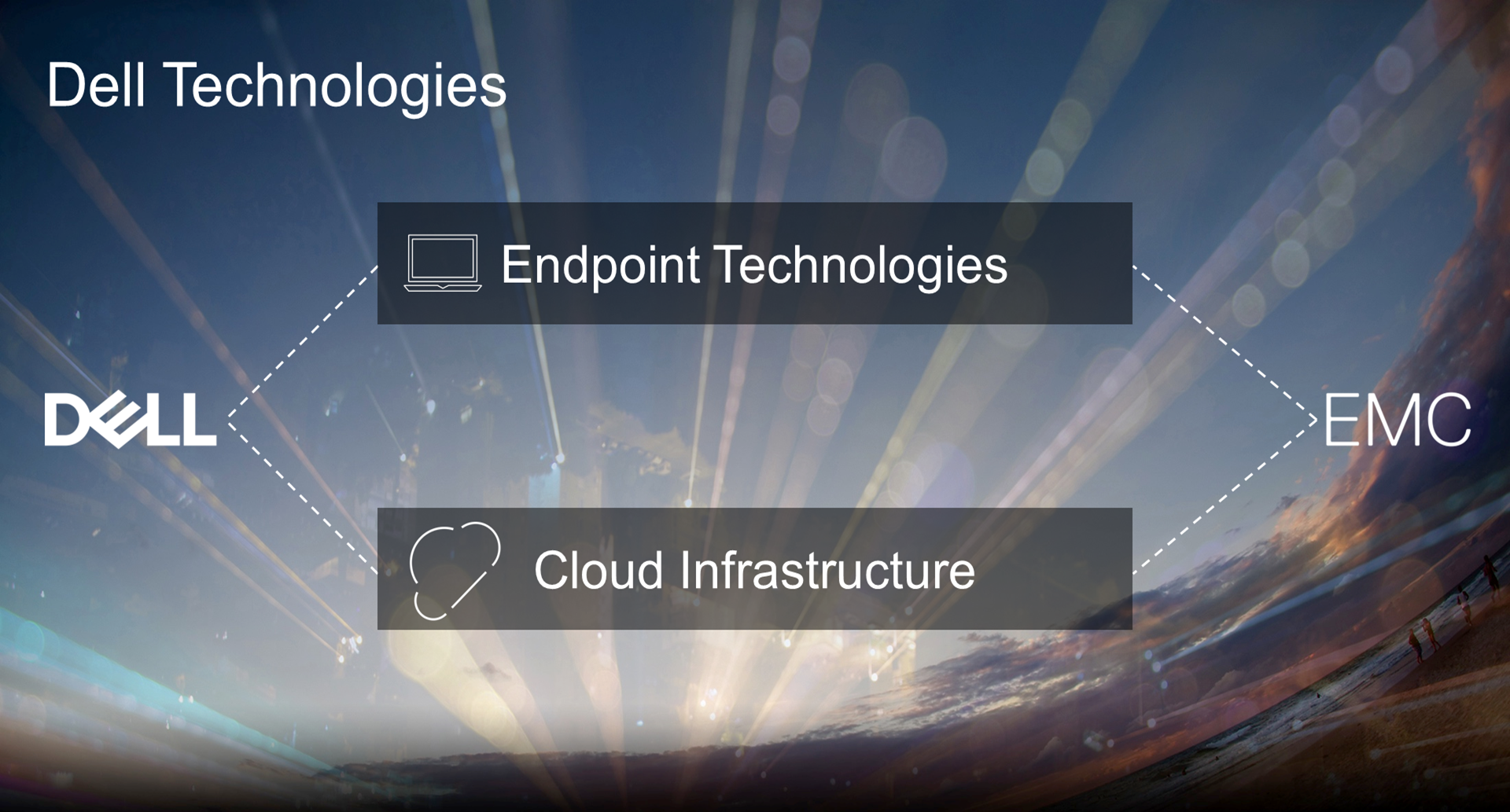
The diagram above provides a simple framework for describing how Dell Technologies will enable companies to innovate in the face of digital disruption:
- The endpoint technologies will accept input from the business ecosystem (people and/or things) in the form of massive unstructured data streams.
- The cloud infrastructure will accept these “analog” streams and turn them into “digital capital” that can perform work (see Wikibon research).
- The cloud infrastructure will put this data to work via automated data pipelining, ultimately resulting in automated business decisions.
- The endpoint technologies are then programmatically invoked to realize these decisions.
Peter Burris of Wikibon best describes item #4 when he comments on controlling the business world via hardware and software actuators:
Digital business enacts through hardware and software actuators that manipulate objects in the physical and social worlds. Actuators can take multiple forms, but we believe business leaders must especially focus on: (1) micro-machines; (2) software bots; (3) virtual reality; (4) programmable compounds (including biological compounds); and (5) most importantly, people. Again, IoT&P is crucial to realizing this aspect of digital business. Through evolving IoT&P investments, and in combination with the [digital business platform], business will have access to a complete cycle of capabilities, from sensing, to making sense, to causing sensation that generates consequential business outcomes.
The interplay between endpoint technologies and cloud infrastructure can now serve as a point of internal collaboration across one company: Dell Technologies. The plumbing and business logic that exists between endpoints and cloud infrastructure will play a critical role in this technology vision. Along those lines, there is a third piece of the Dell Technologies portfolio (Cloud Services) that will serve as a facilitator between these two entities. More to come in an upcoming post.
Steve
Dell Technologies Fellow