
Yesterday I introduced a topic on the EMC Reflections blog called How Much Is Your Data Worth? Today I’d like to spend a bit more time diving into the interview that Gartner’s Doug Laney and I had on The Cube.
The interview took place last month at the MIT Chief Data Officer and Information Quality Symposium. I participated in several Cube interviews on the topic of Data Value. One of the interviews that I personally enjoyed the most was with Gartner VP of Research Doug Laney. Doug kicked off the interview with the following statement:
“Information behaves increasingly as an asset and it is increasingly incumbent upon organizations to manage it, monetize it, and to measure it with the same kind of discipline as other assets”.
Doug went on to state that as many as 80% of executives believe that their corporate data is already listed as an asset on the balance sheet:
“You hardly ever come across an executive that says [data] isn’t an asset but do they track it with the same discipline, principles, and practices as their physical or financial or human capital assets? Not at all.”
Doug went on to mention that listing data on the balance sheet is not only prohibited in the United States but it violates international financial standards as well. Given the wide disconnect between executive assumptions and actual implementations of valuation frameworks, where does one even start to bridge the gap?
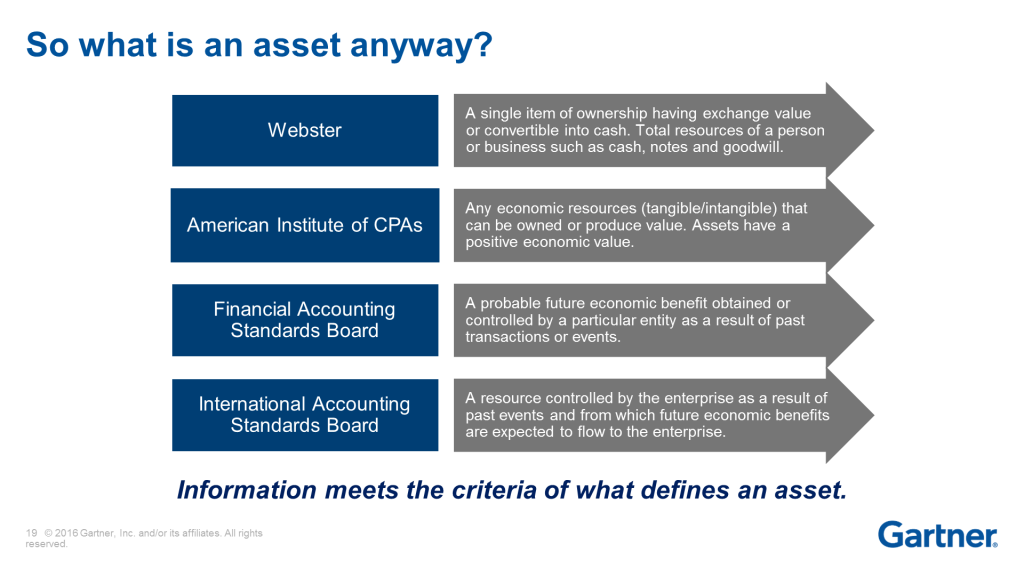
One of the first steps in this process is to take a look at the definition of an “asset” and determine if information meets that description. During one of his presentations Doug used the following slide to explore the definition of an asset:
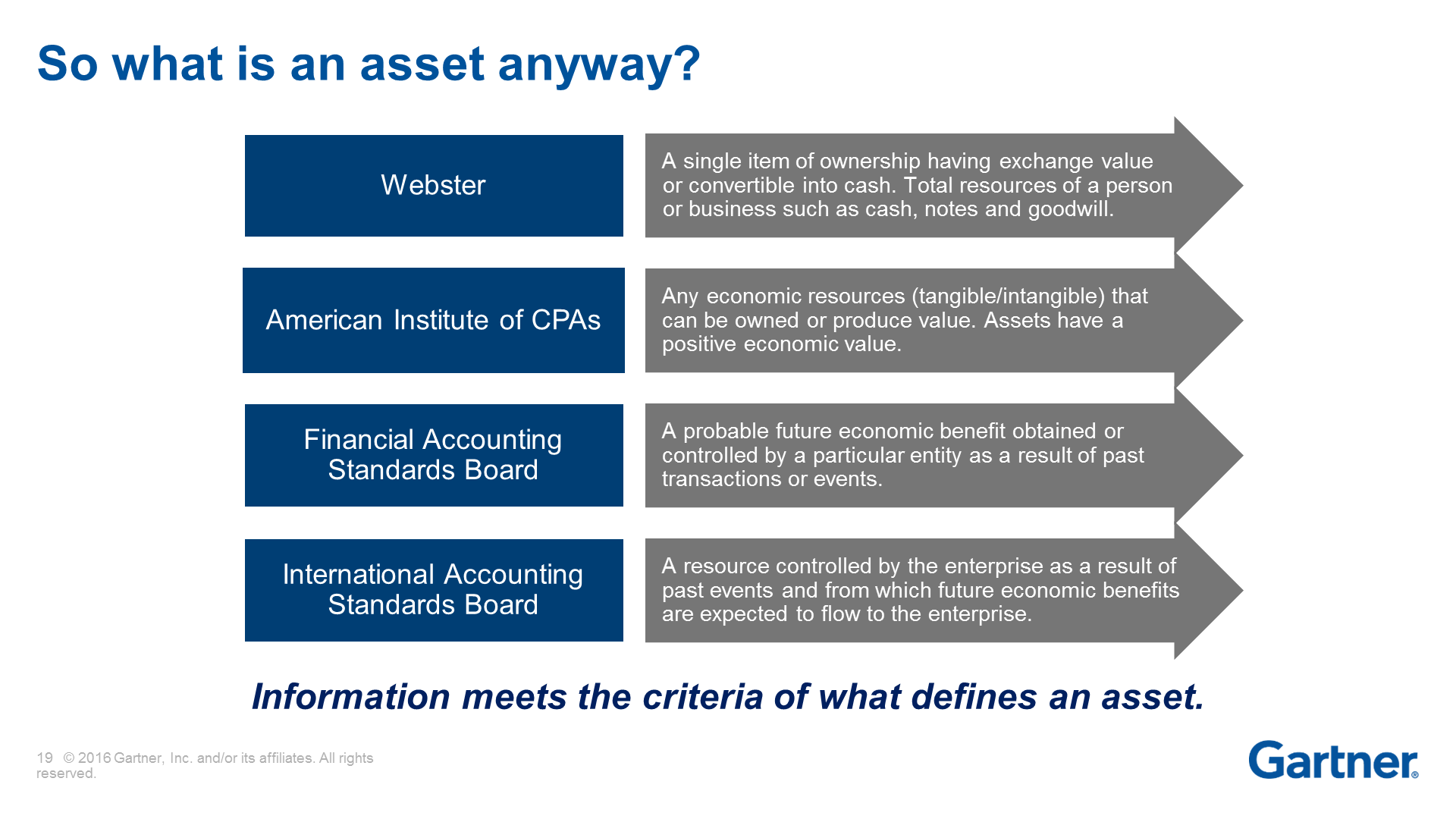
I have come to agree with Doug’s belief that information indeed meets the criteria of what defines an asset:
- It is owned and controlled.
- It is exchangeable for cash.
- It has a probable future economic benefit.
I believe the first step in addressing the perception that data is managed as an asset is to conduct a discussion on the three areas listed above. This will allow the business to compare and contrast how data is measured, managed, and monetized versus more traditional corporate assets. It will highlight the lack of formal platforms and business processes that properly leverage data as an asset (without actually having to list it on a balance sheet).
During the interview with Doug I reflected on how EMC has begun building a corporate framework for treating data as an asset. This framework is being built out by multiple groups within EMC under the guidance of EMC’s Chief Data Governance Officer Barbara Latulippe (who also participated in the EMC Symposium).
For those readers interested in this topic I recommend viewing the entire video (15 minutes) below.
Steve
EMC Fellow