
This is the last in a series of articles that describe the unique traits of a corporate intrapreneur.
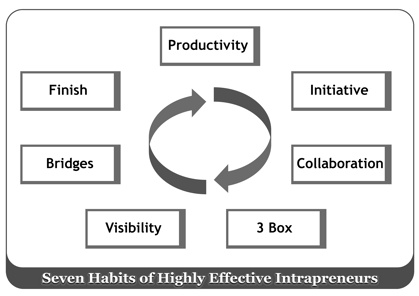
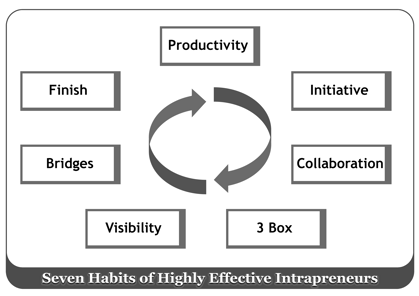
Here is a brief review: the first three habits (productivity, initiative, and collaboration) accelerate idea generation in a corporation. The next three habits (3-Box time Management, Plus-2 Visibility, and Bridge Building) allow an intrapreneur to move forward and ultimately receive corporate approval for completing their idea.
In the diagram below the habit of finishing is closely linked to the habit of productivity.
Many large corporations have dedicated research teams that are not tied to a shipping product. In other cases business units may have advanced development teams whose members propose next-generation technologies but are not directly part of a team that delivers the idea.
Some of the most effective intrapreneurs do not belong to either type of group. They are still in the trenches, striving to deliver the ideas that they themselves helped to generate. They are finishing the delivery of their ideas while simultaneously coming up with more ideas.
Their reputation as a finisher is what gives them the respect of the organization. They don’t propose pie-in-the-sky solutions and leave it to another team to figure it out. They propose customer architectures: architectures that are realizable and deliverable. They close the loop on the cycle by delivering the idea. They stay involved until the job is done. The trait of finishing closes a circle that connects with the first trait of productivity. Intrapreneurs finish because they are productive; it is, after all, their foundational trait.
The first time this cycle is complete, however, holds a special significance. Completing the cycle of idea-to-delivery earns a corporate employee the title of intrapreneur.
Put into action, these seven habits form the framework by which a corporate intrapreneur operates. Entrepreneurs at startups spend a good deal of time chasing funding; intrapreneurs at corporations spend a good deal of time chasing adjacent technologies and collaborative partners.
In my role as the Director of the EMC Innovation Network I've been putting forward this framework as a training curriculum for global employees. The feedback that I've been getting has caused me to believe that while the overall steps are the same, there are cultural variants to many of the phases. I hope to elaborate on these variants in future posts.
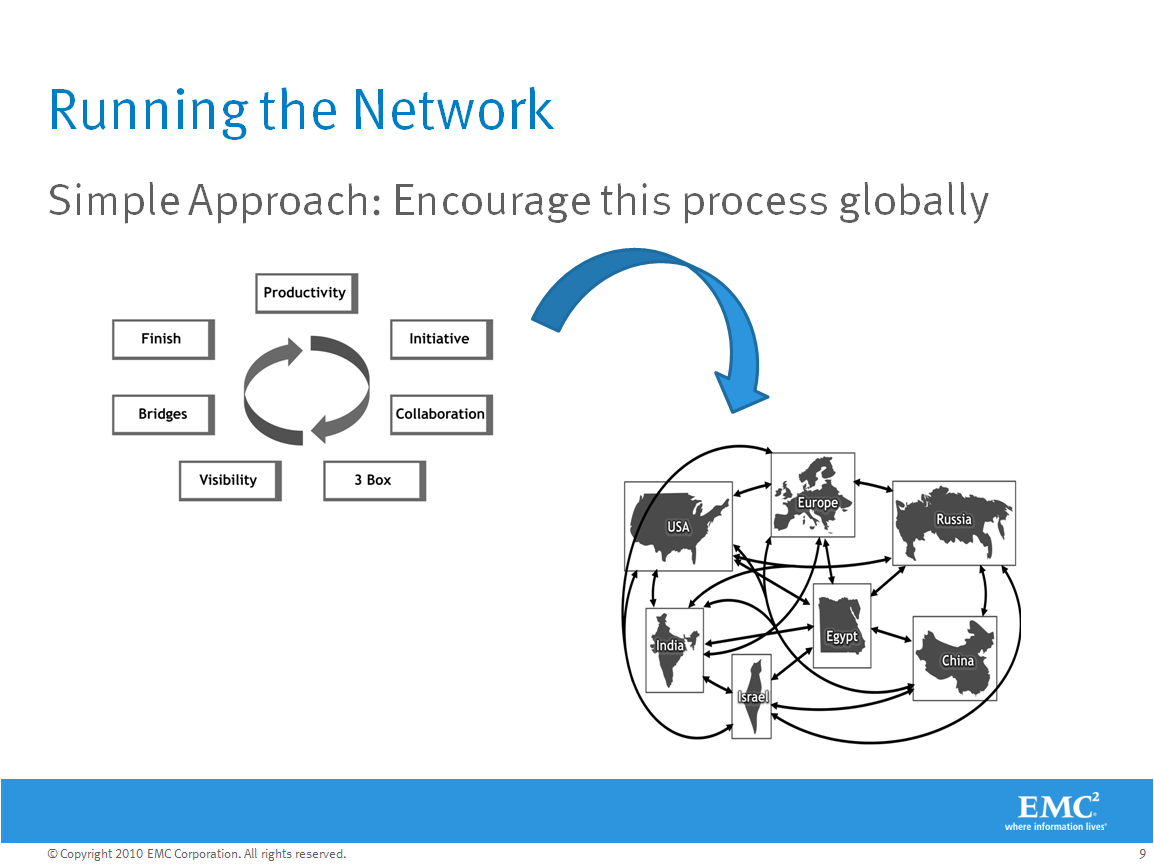
In the meantime, I plan on continuing to write about the use of global innovation analytics. Before getting started, I'd like to close this series of articles by attaching a slide that I use frequently when speaking about innovation to my global co-workers.
The strategy is simple: communicate the intrapreneurial DNA across a 50,000+ person employee base.
Steve
Twitter: @SteveTodd
Director, EMC Innovation Network