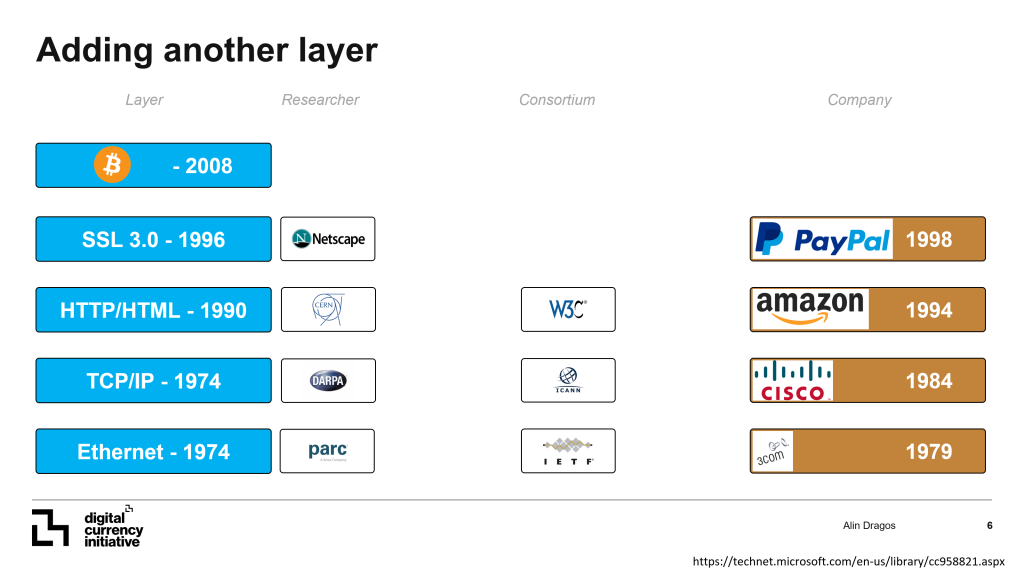

As part of Dell EMC’s collaboration with the MIT Media Lab, we had a visit from Alin Dragos last week. Alin works on the Lightning Network at MIT’s Digital Currency Initiative (DCI). He shared an interesting graphic with us, and with his permission, I have displayed the slide (and his commentary) below. The slide draws from an article by DCI founder (and current Media Lab Director) Joi Ito.
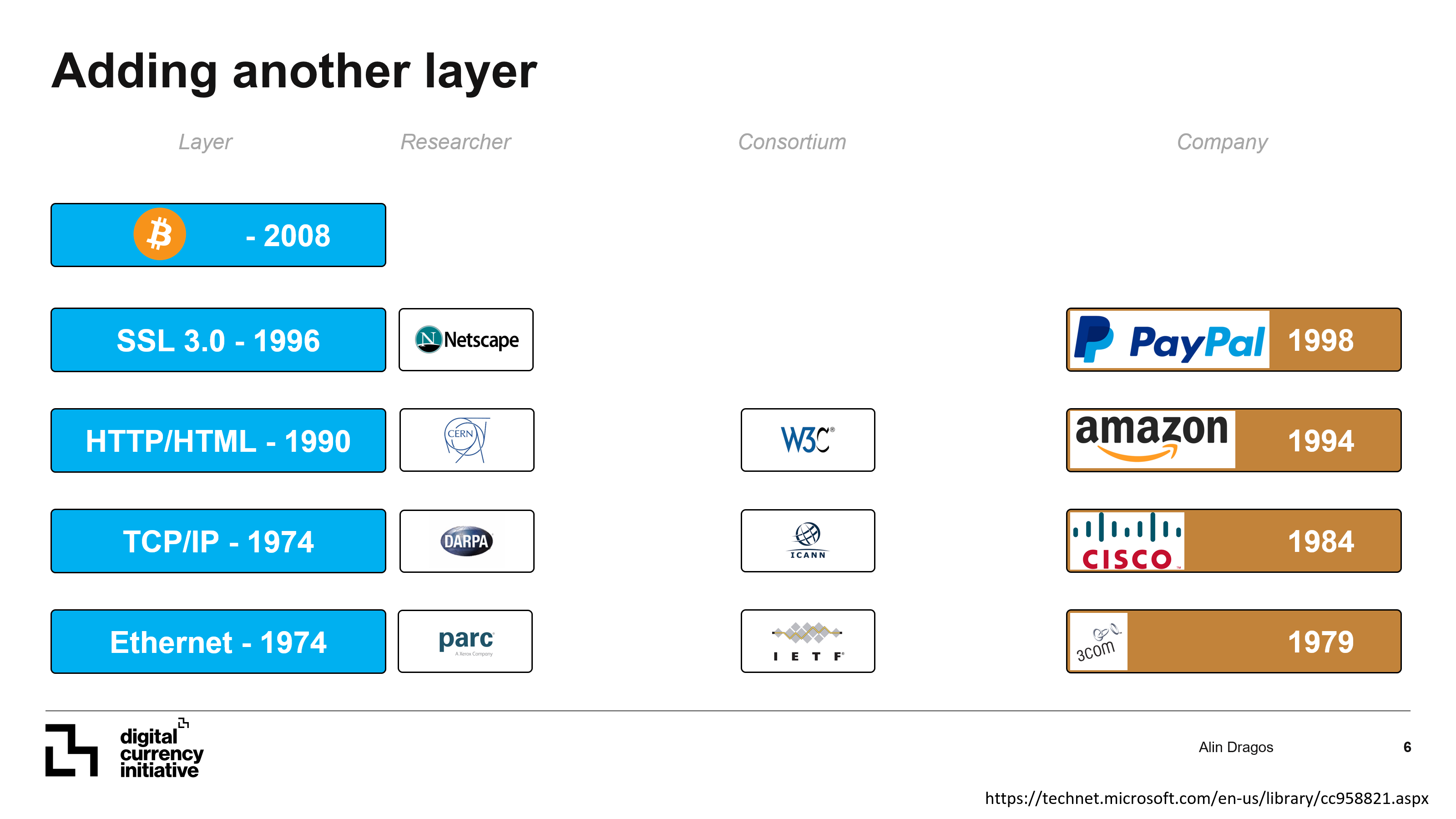
“We believe that what’s happening in the blockchain space now, is similar to what happened when the Internet was built. We observed four major steps – first the Ethernet, which allowed for a way to move information between two computers. It was housed at PARC (Palo Alto Research Institute), with the IETF consortium encouraging collaboration. This also brought us a few years later a dominant player in its field – 3Com. Then, we had TCP/IP, which has its roots at DARPA, and saw a key ally in ICANN. Cisco came to capitalize on the opportunity brought by this technological advancement. Then, we saw another layer develop in HTTP/HTML – started at CERN, and having its own critical consortium – W3C. And that is how we got Amazon. Finally, we saw SSL 3.0, which happened at Netscape, and it brought us Paypal. And that took more than 25 years.” – Alin Dragos (MIT Digital Currency Initiative).
It’s a fascinating hypothesis to think that Bitcoin will become a new, open layer that enables a frictionless and direct transfer of value on the internet. In other words, if Ethernet first allowed a way to move information directly between two computers, Bitcoin may enable a way to transfer value directly between two computers.
Whether or not this vision will become a reality is an excellent debate topic!
It’s entirely possible that some form of “open blockchain” (one that can carry some other type of value) could emerge as an open standard.
This architecture is attractive because it removes friction and delay from financial transactions.
After my talk to legislators last week at the Texas State Capitol, it occurred to me that some states are already preparing for the eventuality of this type of architecture. One such state is Arizona.
Arizona has taken the unique step of legislating against any restriction prohibiting the running of a blockchain within the state.
It would appear that Arizona is betting that removing the friction from value transfer (e.g., transferring value directly to a vendor instead of going through an intermediary) will bring economic benefits to small businesses. This would explain the increased attention that Bitcoins and ICOs are getting in the state. The sponsor of the bill can be seen discussing the anticipated benefits here.
The advancement of blockchain legislation (and solutions) will be an exciting space to watch in 2018.
Steve