
 This afternoon I am speaking at SNIA’s Data Storage Security Summit in Santa Clara. My topic will be Data Valuation to Minimize Monetary Loss. Ever since starting the joint Architecting for Value research with Dr. Jim Short of the San Diego Supercomputer Center, I have been noticing the strong ties between the value of data and the corresponding level of protection based on its value. As I worked to introduce the research topic of Data Value within my own company, I became aware of parallel research within EMC that has emerged from EMC’s RecoverPoint team in Herziliya. In fact the team had already published and presented a paper at the Mediterranean Conference of Information Systems (MCIS) in 2014.
During my presentation I will introduce their “async replication based on value” research as a lead-in for discussing the larger topic of automatically leveraging data’s value in all aspects of IT operation. Although it’s not my goal to explain all the details of their research results at SNIA DSS, I will use the diagrams below to set the stage for the rest of the talk.
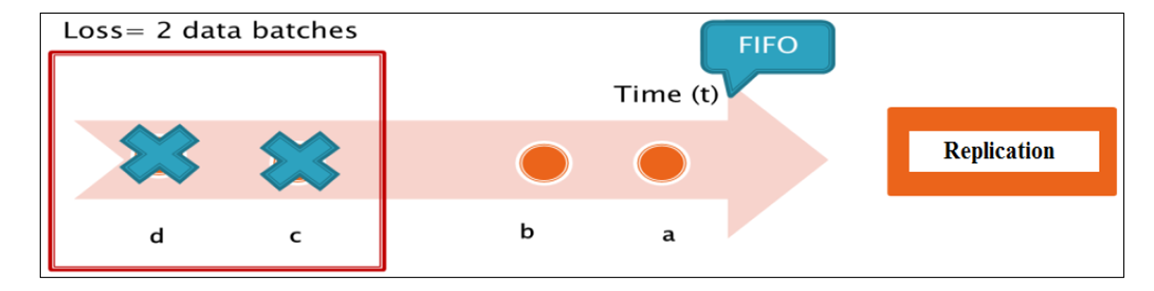
The diagram above represents a processing order for asynchronous replication. Data elements “a” through “d” represent requests coming from different consistency groups. Data elements “a” and “b” have been successfully replicated to a remote system. Data elements “c” and “d” experience a failure that prevents replication.
How much business value is specifically jeopardized due to this failure? If we knew specifically how much business value is associated with data elements a-d, could we order them differently to minimize potential business loss? This is exactly the question that Peleg Yiftachel and Udi Shemer from the RecoverPoint team were attempting to answer. They launched a research initiative with Ben-Gurion University of the Negev, led by Omer Sagi, and came up with an approach for assigning value to data, and then adjusted their replication algorithms based on that assigned value.
Using live traffic captured from customer sites, they then simulated the execution of value-aware replication algorithms and achieved the following results:
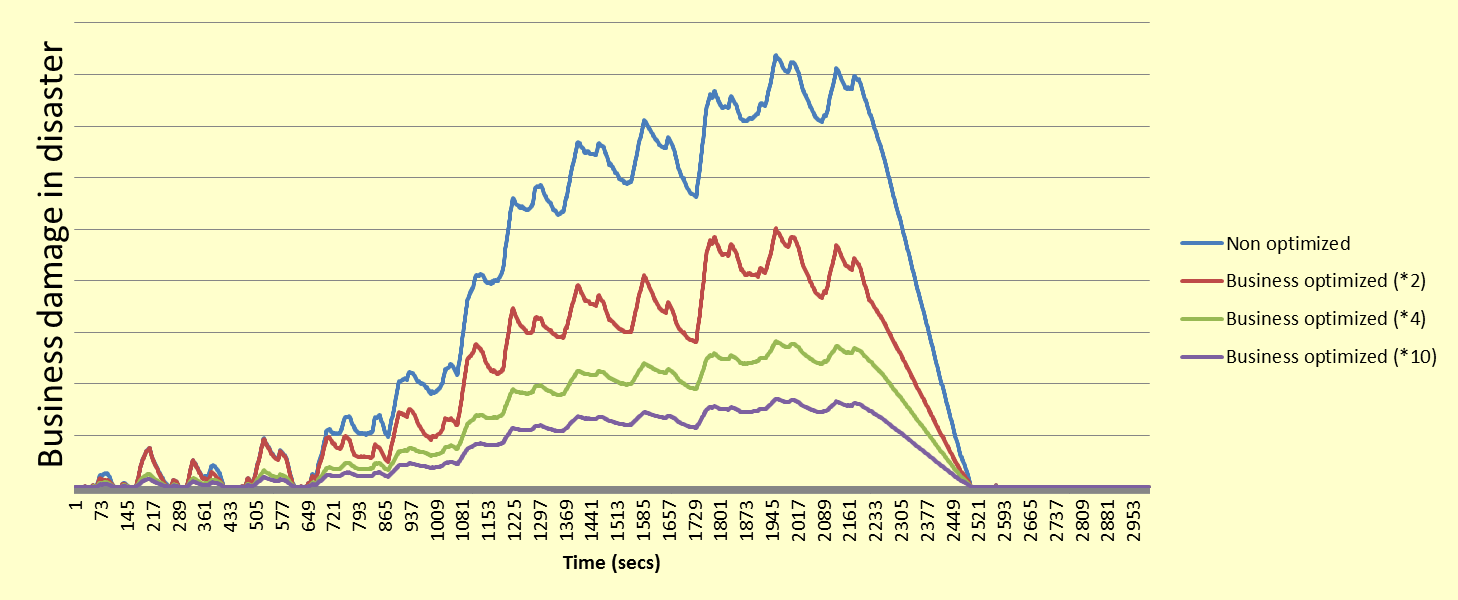
The top (blue) line communicates business damage using the traditional replication algorithms. The graph represents the amount of financial damage a business could experience due to the lag in asynchronous processing of the replication queue (note that at t=2521 the simulation reaches the end of the captured traffic stream).
Using a value-based approach, the team discovered that their algorithms resulted in significantly less potential business damage in the face of an outage.
I recommend contacting the authors for a full description of their approach and their results. For me it raises a higher-level question. Given the potential for value-based replication algorithms to significantly decrease business risk, and given there are likely other areas (migration, provisioning, etc) that could benefit from the awareness of data’s value, how do we calculate this value and pass it down to the infrastructure?
This is the focus of my talk. I’m looking forward to engaging with like-minded members of the data protection community and hope that some of the results can be seen on social media as we explore the possibilities.
Steve
Dell Technologies Fellow