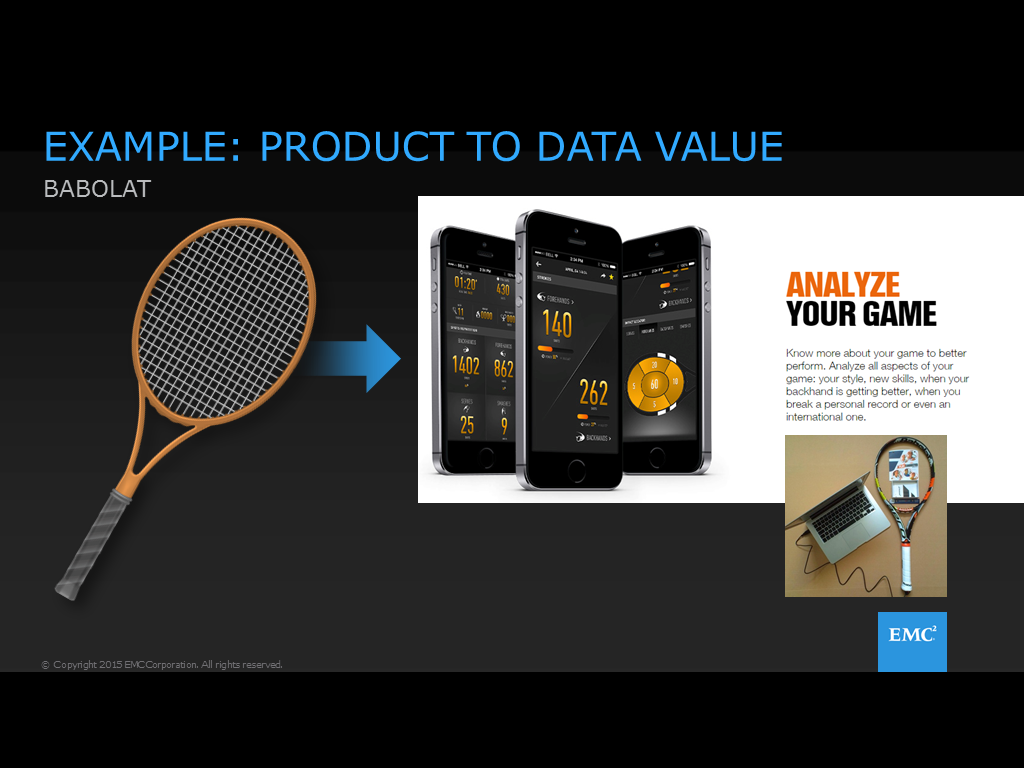

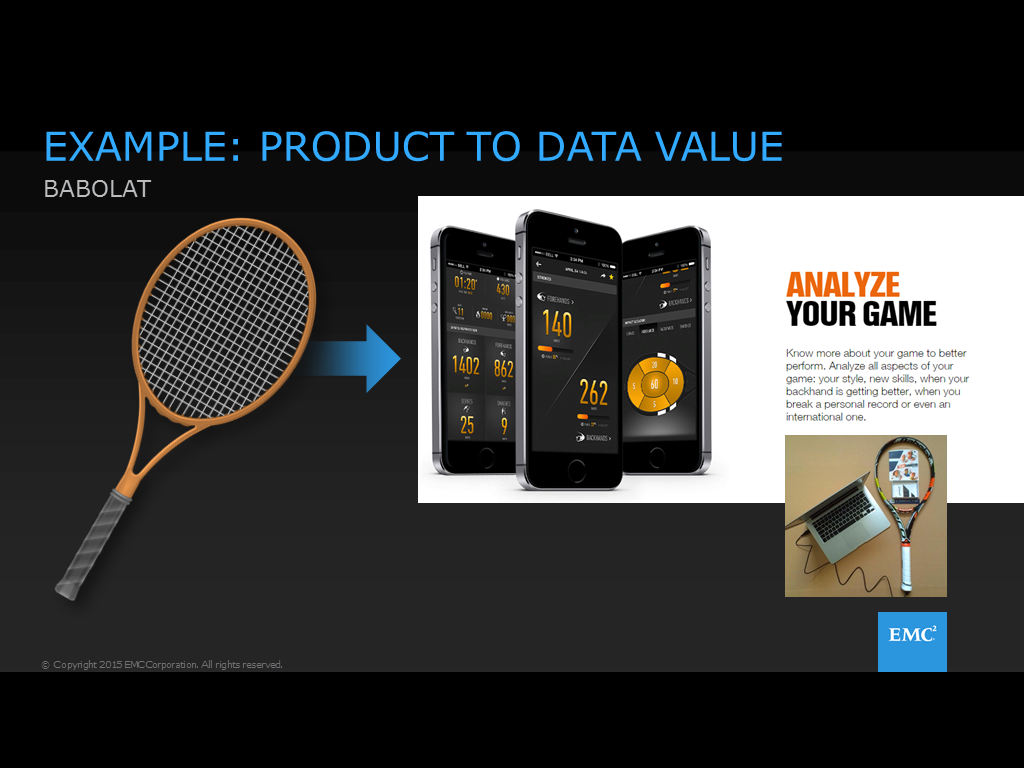
A little over a year ago I began sharing some of the preliminary results of EMC’s Architecting for Value research partnership with Dr. Jim Short from the San Diego Supercomputer Center. One of the key findings was the value shift from products to data. The research was showing that established corporations had a strong desire to augment their product revenues with data revenues. We used the graphic below to highlight one company (Babolat) who was successfully navigating the shift from product value to data value.
Fast forward one year and the same message was resonating loud and clear at last week’s MIT’s Chief Data Officer and Information Quality Symposium. Keynote speaker Tom Davenport drove home this point several times during his Thursday morning presentation: “Four Eras of Information, Four CDO Roles”. Tom framed the shift from products to data value in terms of learning to play “offense” AND “defense”.
One of his warnings to the CDO audience was to avoid the trap of only playing defense: governance, data cleansing, cyber-prevention/detection, etc. These tasks will typically get you noticed only if something goes wrong. He mentioned that while these tasks are necessary, they should be augmented with a set of value-added activities that allow the CDO to go on the offensive:
- Supporting analytics across the enterprise
- fostering self-service for data
- building a data lake
- engaging the business in data product development
Encouraging the business to develop “data products” means that the CDO has the opportunity to transition their company from selling products (e.g. tennis rackets) to selling products + data services (e.g. applications that provide services over sensor or other types of data).
A key strategy for Chief Data Officers to facilitate the shift to data products and services is the creation of APIs for data. During his follow-up interview with The Cube, Tom stated that we are in an “API economy”, where companies like Google have created data products (e.g. search). They test the market by offering the products for free, but if there is money to be made they can start charging. The full interview can be found below:
Tom made many other points about the evolution of the CDO role that I plan on thinking and writing about in future posts. I also plan on highlighting the API-based approach that EMC is taking within its own internal Data Governance framework. This framework is already tracking value parameters and can be augmented to help Chief Data Officers move from “defensive” governance to “offensive” valuation.
Steve
EMC Fellow