
I’ve been blogging my way through some of the vision and messaging unveiled by John Roese at EMC World several weeks ago. One of John’s main themes was that of “Arming the Enterprise” for new Cloud/Big Data/Mobile/Social workloads. These new workloads are driving the industry towards what IDC refers to as the “3rd Platform“.
In my last post I shared the diagram below:
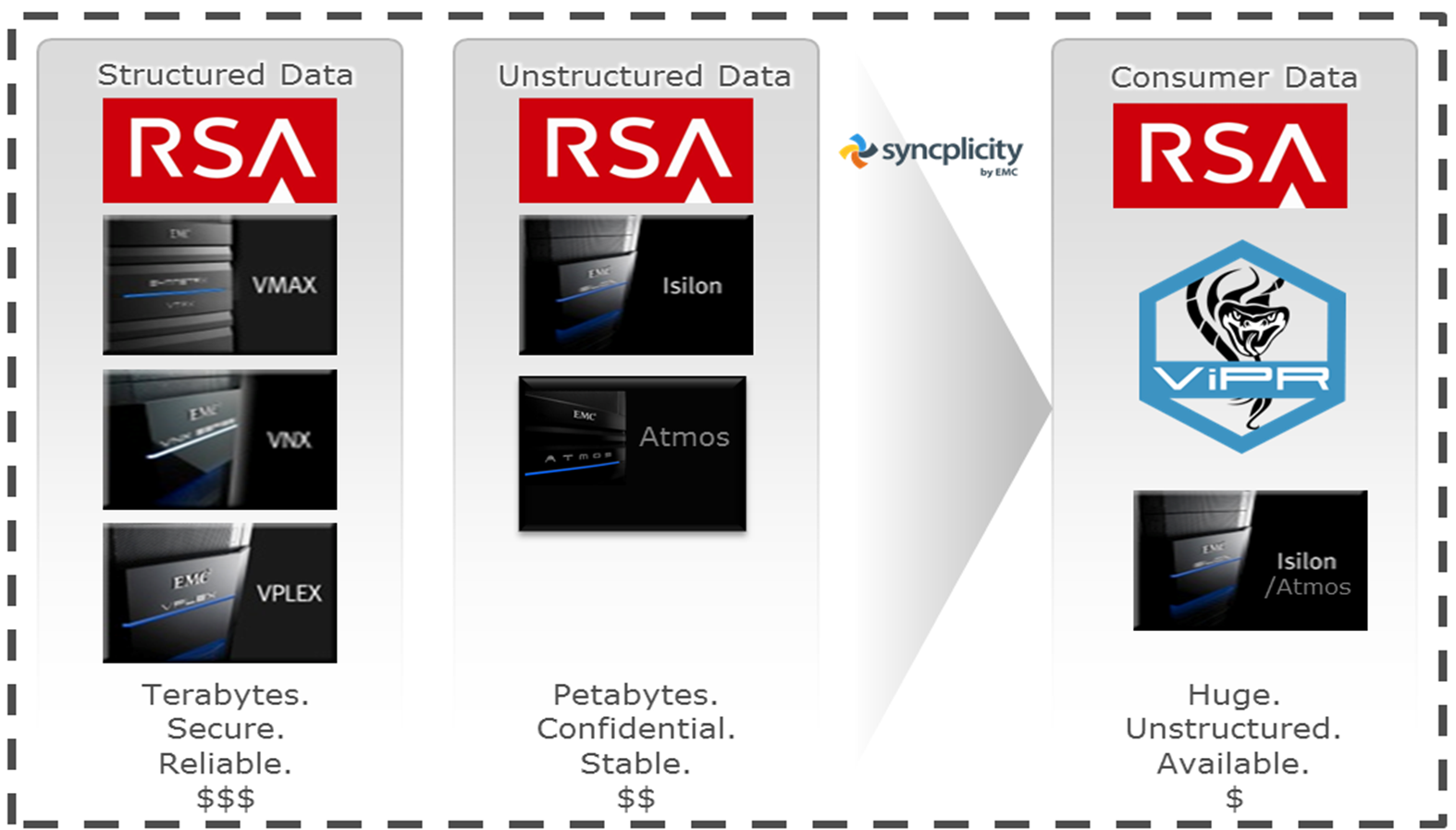
This diagram is meant to highlight EMC’s portfolio evolution to accomodate evolving workloads. The use case above is Health Care, but the reality is that many different verticals (e.g. Financial) have undergone a similar transition. Below is a description of the workload and technology solutions (going from left to right over time):
- Terabytes of high performance, highly reliable, and heavily regulated storage devices (VNX, VMAX, VPLEX) essentially “run the business” inside a hospital, with items like Electronic Health Records (EHR) protected by RSA.
- Hospital workloads expand to digital media applications such as telemedicine and digital pathology. EMC’s portfolio adds Isilon and/or Atmos support at a lower price point. Confidentiality is still preserved using RSA technology. The previous workloads (e.g. EHR) must exist alongside the new technology.
- The enterprise IT infrastructure must extend the boundary of their data center to manage and incorporate huge amounts of consumer data. Once again, the EMC portfolio has expanded to incorporate these new workloads in a secure fashion. During EMC World, there was a heavy emphasis on new offerings that assist the enterprise to address these new workloads: RSA, Isilon and Atmos, ViPR, and Syncplicity.
The characteristics of these new workloads, and the ramifications on the IT infrastructure, are as follows:
- The amount of consumer data has evolved to petabytes.
- There is enormous pricing pressure to manage that much capacity. Analytics upon that raw data generates additional results that must be stored and managed.
- There is a strong desire to analyze consumer data in the context of the existing enterprise information assets (e.g. EHR, Digital Pathology). This improves end-to-end wellness management.
- Heterogeneous storage, ranging from high-end to consumer storage, must be managed in a way that significantly reduces OPEX.
- Consumers will expect a “mobile-friendly” user interface that can seamlessly move data into the enterprise in a protected manner.
- Hundreds of millions of users will participate in this third platform ecosystem. The overall system must be able to detect malicious behavioral patterns.
- Customers wish to add Hadoop-style analytics to their toolkits.
Let’s step through some of the recent additions and enhancements to the EMC portfolio that enable enterprise customers to extend their reach and meet the requirements of the new workloads:
Syncplicity
The Syncplicity acquisition (May of 2012) serves as a significant milestone on the road to the mobile requirements of a third platform achitecture. After the acquisition, Syncplicity was modified to interoperate with enterprise home directories sitting on top of products such as VNX and Isilon (i.e. the enterprise assets already existing within the data center). This allows enterprise employees and/or customers to take any enterprise information and mobilize it onto any type of portable device and vice-versa. The user interface is consumer-friendly and natural. In the context of health care, E-wellness and M-health applications now have a path to interoperability and exchange with the enterprise infrastructure.
RSA
RSA technologies have shown up in every phase of workload transition (as evidenced by the diagram above). Enterprise customers have asked RSA to extend its reach, and the RSA portfolio has also undergone an evolution in two key areas. Firstly, they’ve added support for security analytics. Third platform architectures will have hundreds of millions of events to analyze. As a result, RSA pushed the envelope of Security Information and Event Management (SIEM) by using analytics as a way to detect intrusions. Secondly, they have added new products such as SilverTail. This product uses real time web session intelligence and behavioral analysis to defend against cyber crime. RSA has augmented its strength in the enterprise with technologies that clearly have business-to-consumer benefits.
ViPR
ViPR will extend the enterprise storage footprint to accomodate new protocols and APIs such as S3 and HDFS (which were not required by the previous enterprise workloads). What does this mean? The customer can actually open up traditional enterprise storage products like VMAX, VNX, and Isilon to protocols such as S3, without modifying those traditional systems. You may not balance protocols such as S3 on top of those systems by default, but there may be other reasons for combining the traditional workloads from those systems with consumer data.
Furthermore, the diagram above highlights the different types of storage platforms required to handle the evolving variety of workloads. The operating complexity of the IT infrastructure is going up. ViPRs aspires to serve as a horizontal layer of software across a diverse set of storage infrastructure, abstracting the differences and forming a coherent system. It represents a consistent way to look down into a diverging, complex infrastructure with different workloads and “treat it like a system”.
Regardless of the workloads deployed and the underlying IT infrastructure, the vision of ViPR is to sit on top of all of it and behave like a system.
And finally, Isilon and Atmos are becoming more scalable and hitting different economic price points. Atmos has always had object support, and Isilon is adding these features as well. This allows customers who have already invested in products like Isilon additionally leverage it for object support.
This post has been about evolution. In subsequent posts I will discuss two horizontal strategies that cut across every vertical tier in the diagram above: Flash and Analytics.
Steve
Twitter: @SteveTodd
EMC Fellow