

For my last post of the year I’ll stick with tradition and tabulate the output from the photovoltaic solar panels that I installed on my roof in 2007. I wrote a year-end post in 2008 that listed the kilowatt hours and described my system.

Since the install in 2007 the system has generated roughly 5 megawatts of power.
The solar technology is an adjacent sphere of innovation that I’ve started to combine with EMC’s product line. One of the tough parts about blogging for EMC is the fine line I have to walk when it comes to writing about the futuristic stuff that I’ve been working on. I’d prefer to be 100% open. For my last post of the year I’d like to unveil a cool new direction that is sure to result in significant press coverage in 2010.
I’ve spent a good deal of 2009 pondering the different alternatives for handling explosive information growth. The rate of growth is simply incredible. There are planetary constraints for storing this much information! Part of the solution is the deployment of globally distributed storage systems like Atmos. In fact, I wrote a post earlier this year that describes the potential for automated migration of data to geographic locations that support either lower electricity rates or spin-down technology (or both).
The acquisition of Data Domain is in large part due to this explosive data growth. DD will shrink down the amount of data to be stored. This is very effective, and should give us several years respite when it comes to the planet’s ability to store information.
What you’ll start to see in 2010, however, is out of this world.
I’m pleased to announce EMC’s next game-changer: Fully Automated Solar Tiering.
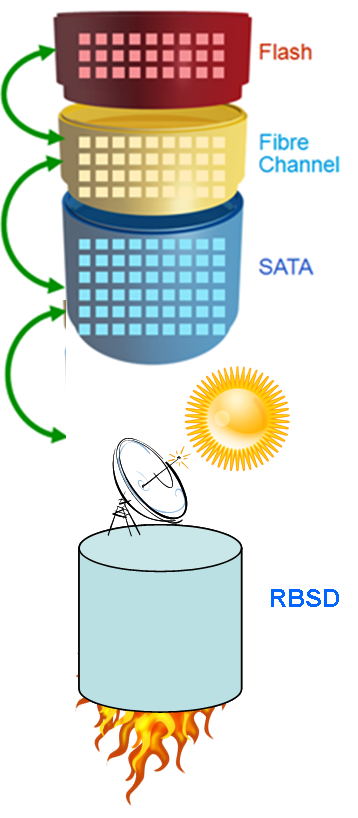
Fully automated solar tiering will bring us to a world where huge solar-powered data banks will house large numbers of RBSDs (Rocket-based Solar Drives) and house the bulk of the world’s information. I came up with the idea during a snowstorm. The solar panels on the roof of my house were buried under a foot of snow and were rendered useless. I quickly realized that if my house was in outer space I wouldn’t have this problem (because there’s no snow in outer space). When I went to work the next day, the light bulb just went on! Huge banks of storage devices could be eternally powered by the sun! The only other energy required would be small amounts of rocket fuel to continually position the RBSDs in view of the sun.
I built a prototype, starting with the re-usable FAST technology here at EMC. It’s quite easy to add another tier. I had to tweak some of the paging algorithms to support galactic distances. Other than that, it all works. When will it be ready? Of course, the devil is in the details. There are two problems that require a “finishing touch”.
- Eclipses. Shouldn’t be too hard to take solar blockages into account.
- Asteroids. I plan on re-using some software from the 80s to make sure that customer data doesn’t take a direct hit. There’s a great asteroid avoidance algorithm (AAA) that I found here.
Every great idea struggles to be productized. Believe it or not, reaction within EMC has been mixed. Requests for reimbursement of my solar panel install have been repeatedly denied. Expense reports for research trips to the Caribbean have been rejected (C’mon, it’s wicked sunny down there!). Between you and me, I think the idea has pretty solid venture capital potential.
The sun will rise on innovation in 2010. Happy New Year to you and yours!
Steve
http://stevetodd.typepad.com
Twitter: @SteveTodd
EMC Intrapreneur



Man, who’s going to be the unlucky IT flunky to get the call in the middle of the night to swap out a bad drive in space?
C’mon, who wants to have their storage powered by Sun?
@IT Flunky: Get your G-Suit on!
@Jeff: Can you have law-suits in space?
It will never work. In space, no one can hear your data stream.
– Prior to mount RBSD better to try regions where sun shines 300 day a year (at least as a sandbox)
– even in case of RBSD, there should be SSDs mounted there, not spinning disks