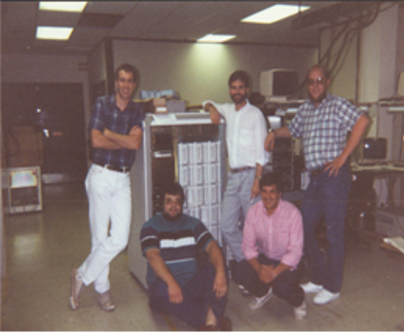

RAID-5 is common in the storage industry. Are you taking it for granted? Before you do, hear my story. You see, once upon a time, RAID-5 didn’t exist…..
October of 1988 was a busy month for me.
I began building CLARiiON’s RAID-5 software at the beginning of 10-88, and I got married at the end of 10-88. It’s nearly twenty years later and I’m pleased to report happiness on both fronts, and now I’m ready to blog. Blogging about my marriage would likely disrupt said happiness.
So let’s talk RAID-5.
In October of ’88, the RAID-5 software existed only on my whiteboard. By 2008, the real thing has been running in at least a quarter of a million CLARiiON deployments. I like to think that this number is conservative. But the point is that CLARiiON continues to be the customer choice for RAID-5, whether you spend less than $10K or whether you spend more than six figures.
RAID-5 is rising
Don’t get me wrong. I had no idea that twenty years later, RAID-5 adoption would be continually increasing. And to be honest, although I knew that our implementation was good stuff, wouldn’t it be a matter of time before the competition caught up, or another storage buzzword took over? Well, it hasn’t happened.
And I believe that the reason it hasn’t happened is primarily a software reason. There were some fundamental choices made in the design of CLARiiON’s RAID-5 implementation that still hold true. Most of the decisions were made in the two years subsequent to October of 1988. I plan on writing about those decisions.
But Let’s Define RAID
Does the “I” in RAID mean independent, or inexpensive? Who defines RAID? What’s the purpose?
For me, RAID-5 started with the Berkeley paper. As a matter of fact, that’s how my involvement started. My boss handed me the Berkeley paper and said “build RAID-5”. And so I read the paper. And I discovered it was about two things: (1) Performance, and (2) Data Integrity in the face of disk failures.
That’s my definition of RAID: it’s purpose is to be fast; it’s duty is to protect data. Twenty years later I’m still hearing that customers buy CLARiiON because it’s (a) fast, and (b) trusted.
So What’s The Secret Sauce?
As a recent college graduate (B.S.C.S University of New Hampshire), it was my first big “homework” assignment. I understood the RAID algorithms. I understood striping data across multiple disk drives. I understood reading and writing disk drives. I understood getting the most out of disk performance.
But I didn’t understand how tough it would be to provide data integrity… in the face of disk failures… in the face of any failure.
Yes RAID is meant to be fast. But fast and incorrect is unacceptable.
Therein lies the secret sauce. Our software foundation would focus on data integrity; no matter what failure might occur, preservation and correctness of customer data would be paramount. This software strategy had multiple facets; I plan on blogging about many of them.
I quickly learned that protecting customer data was harder than your average homework assignment.
The Information Playground
I don’t directly work on RAID-5 anymore. I moved on to hot repair. Then failover. And then write cache. And then Navisphere, Storage Scope, PowerPath, Centera, …. you get my drift. Think about the acquisitions EMC has made this decade. Now imagine being a software engineer trying to put them together in new ways. That’s what I do. At least, that’s what I’m supposed to do (blogging isn’t part of our development schedules, at least not yet).
Each week I’m interfacing with my co-workers in Russia, Belgium, China, India, and all throughout the U.S. and the rest of the world. Believe me, you’d like working here.
Welcome to the Information Playground….don’t tell my manager.
Steve


The death knell for RAID?
Ingenuity in storage is evolutionary — but clustered storage could be the revolution that replaces RAID Defining the single-most significant change in storage I have seen throughout the years could easily lead to multiple discussion threads. After all…
Greetings & Well Wishes
To Mario & Steve:
Of course there are shortcomings with any software but the knelling of RAID, you can forget that. 1st of
all it’s to much of an important real-functional asset of high-end servers: 2nd of all as a software it has to be updated (as a software): & 3rd, Makers of high-end server have to be reminded to update their RAID Software (which is usually combination of other applcs. used in implementing disks redundancy, partitioning, & formatting). Systems Tunning.
Sign,
Sayyid Ahmad