
When I think about the type of fixed content that is traditionally stored on a Centera there are several use cases that come to mind.
Medical images. Scanned check images. Mortgage applications. Anything that comes from a scanner. E-mail. Electronic files.
All of these use cases represent content that is not likely to be "opened and edited".
Lately I've been reading a lot about another use case that makes perfect sense for Centera.
Phone calls.
Picture a large call center handling 1000s of calls each day. As soon as each call ends, the entire conversation becomes fixed content. Months later a customer may file a complaint about a service that was promised during a particular phone call. How can you find the call? Was it deleted? Is it authentic? Is it on tape somewhere?
One of the worldwide leaders in multimedia recording solutions is NICE, and NICE has integrated Centera into their solution. For example, NICE's Perform product archives phone calls to Centera and then provides a wide suite of analysis tools such as word spotting, emotion detection, and voice analysis. This type of capability is valuable in any market that utilizes a large call center, including public safety, finance, retail, etc.
Integration Details
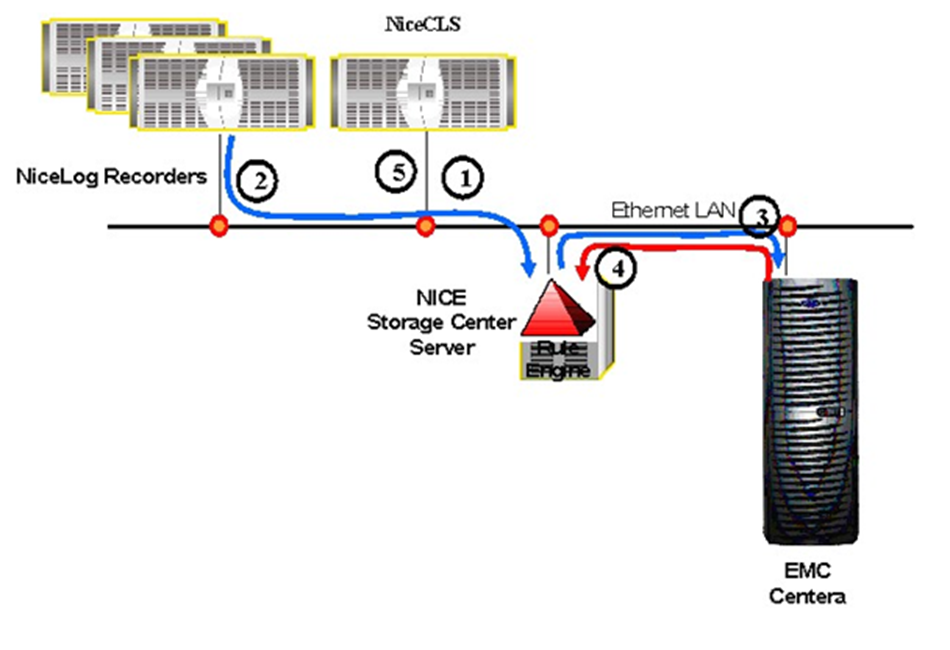
NICE and Centera integrate via NICE's Storage Center Server (SCS), an architectural component which is responsible for storing and tracking all phone calls entering the system. The SCS pulls previously stored calls from NiceLog Recorders (pictured below), stores each call to Centera, and receives a Centera content address (CA) in return. This CA is stored in an SCS database along with other information about the call.
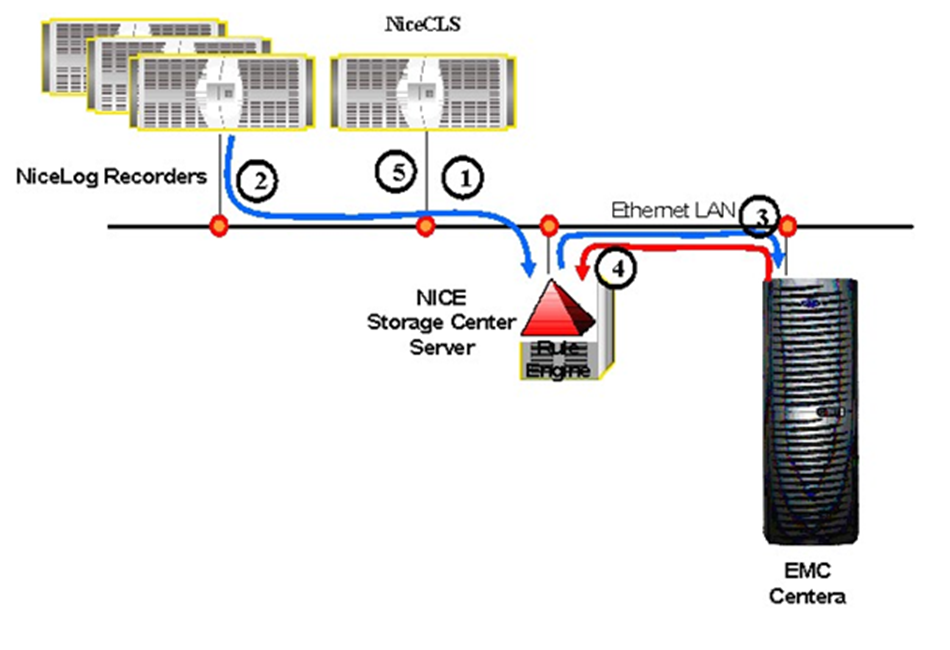
The SCS contains software that has integrated with the Centera SDK. This SDK integration takes advantage of the following Centera features:
- Multi-pathing: The SCS administrator can enter the IP addresses of up to four Centera ports in order to realize load balancing and multi-pathing to the Centera system.
- Automated DR failover: The SCS administrator can also enter the IP address of a replica Centera system in order to continue in the face of a disconnect from the primary Centera.
- Metadata annotation: The SCS is able to use Centera's metadata feature to annotate the phone call being archived. For example, the name of the SCS application can be stored along with the phone call.
- Retention: The SCS always stores a retention field in the Centera metadata associated with each phone call. Centera enforces "disallow delete" based on this field. The time is based on the call arrival time (not call archive time).
- Multi-Threading: The SCS fires up multiple threads (default of 20) to allow parallelization in the ingest of phone calls. This is particularly useful if batches of phone calls are archived at night, for example.
- Shredding: Once phone calls do expire, there is often a need to shred the phone call electronically. Centera supports this.
The Centera integration has been successful to the point where NICE refers to a Centera deployment as a "best practice". Over 100 NICE/Centera deployments are in the field. The NICE/Centera integration has eliminated a lot of headaches that used to occur with phone call archiving, including finding/loading tapes, proof of originality/authenticity (provided by Centera's content address), and configuration-free capacity upgrade.
NICE Wholistic Approach
I don't want to shortchange NICE by highlighting just the audio aspects of the Perform product. NICE has a much larger portfolio that can also archive customer interactions such as email exchanges, web interactions, video, etc. NICE provides wholistic management of all of these use cases (which all represent fixed content, by the way).
What I did want to highlight was the unique value proposition gained by NICE several years ago due to the fact that the NICE developers integrated with Centera.
One more interesting point of note: converting the NICE SCS to use the XAM API would not only maintain compatibility with already stored audio files, but it would also provide NICE customers with the flexibility of moving to future (XAM-based) archival systems.
Steve