
 Last week I spoke at Evanta’s Global CIO Executive Summit at the Skytop Lodge in Pennsylvania. My keynote focused on Data’s Economic Value in the Age of Digital Business. One of the themes of the conference was “Innovate – Execute – Results”. During the session we discussed (a) several years of innovation in the area of data value, (b) a status update on some of the internal execution on those ideas, and (c) the industry results for calculating the value of data. In this post I will begin to socialize the five key insights that were shared during the session.
First Key Insight: CIOs Need to Insert Themselves Into the Data Value Conversation
Consider the following statement from a joint 2014 Big Data Report conducted with Capgemini:
“Among our respondents, 63% consider that the monetization of data could eventually become as valuable to their organizations as their existing products and services”.
Effective data monetization requires data valuation. As the industry struggled with data valuation in 2014, EMC commissioned San Diego Supercomputer Center’s Jim Short to survey the state of the industry. Jim documented the use cases and came to the following conclusions:
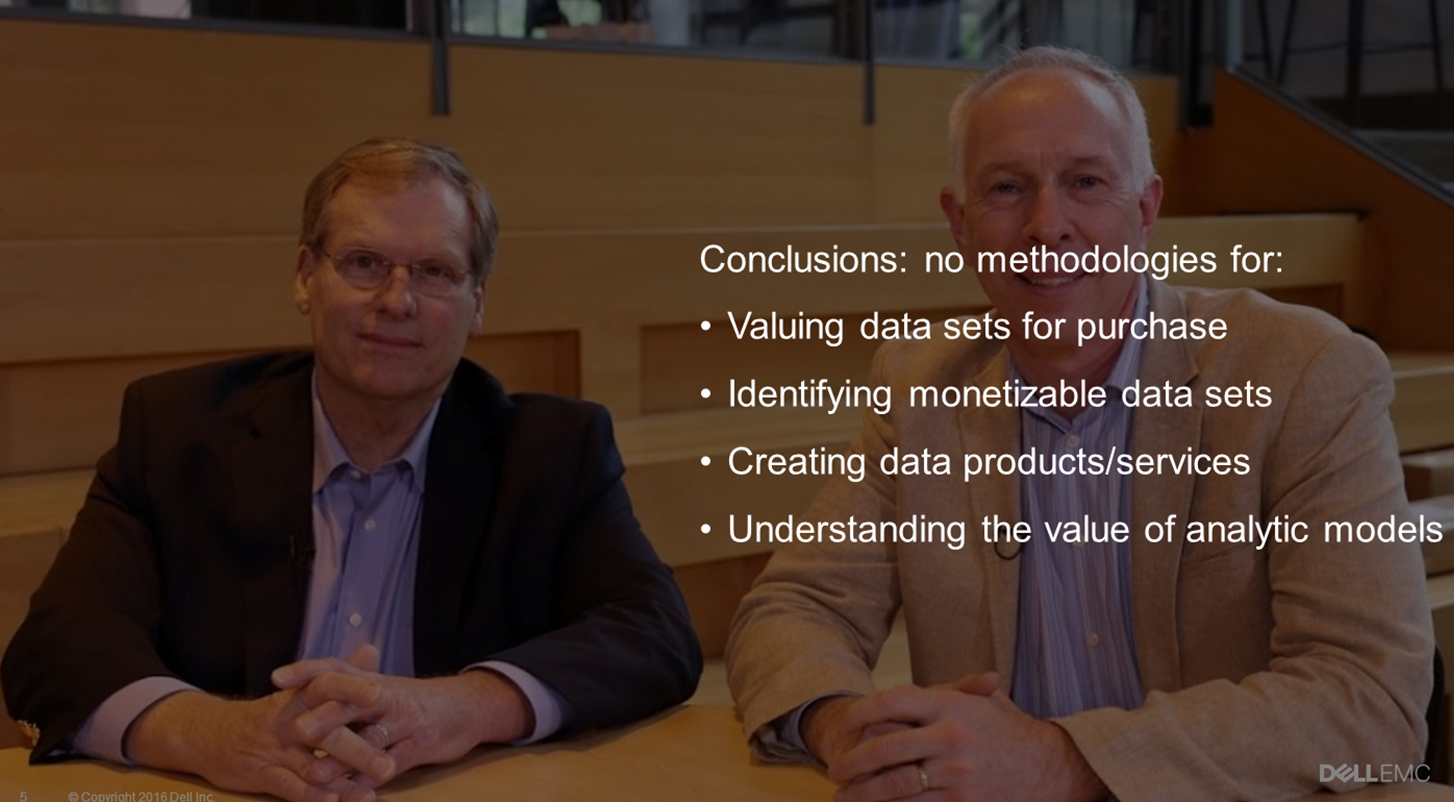
Jim’s research highlighted a number of data valuation struggles that are occurring in the industry. There is a lack of capability to….
- accurately price data assets for sale/purchase
- identify which data assets within an organization are the “most monetizable”
- turn those assets into new products and services
- understand which specific analytic models within an organization have resulted in business results
Many of Jim’s thoughts on this research were recorded at the July 2016 Chief Data Officer and Information Quality Symposium.
While there are no established business processes in place for data valuation, we did find that conversations on data value have started. These conversations, however, are typically not being held with the CIO. It is imperative that the CIO inserts him/herself into these conversations because IT support will be required for effective valuation.
There are numerous examples of industry experts driving valuation conversations.
BIll Schmarzo has laid out a framework for two different valuation discussions that he is having with Chief Data Officers. In each post Bill details a step by step approach to
- associate business value with data.
- associate business value with analytic models.
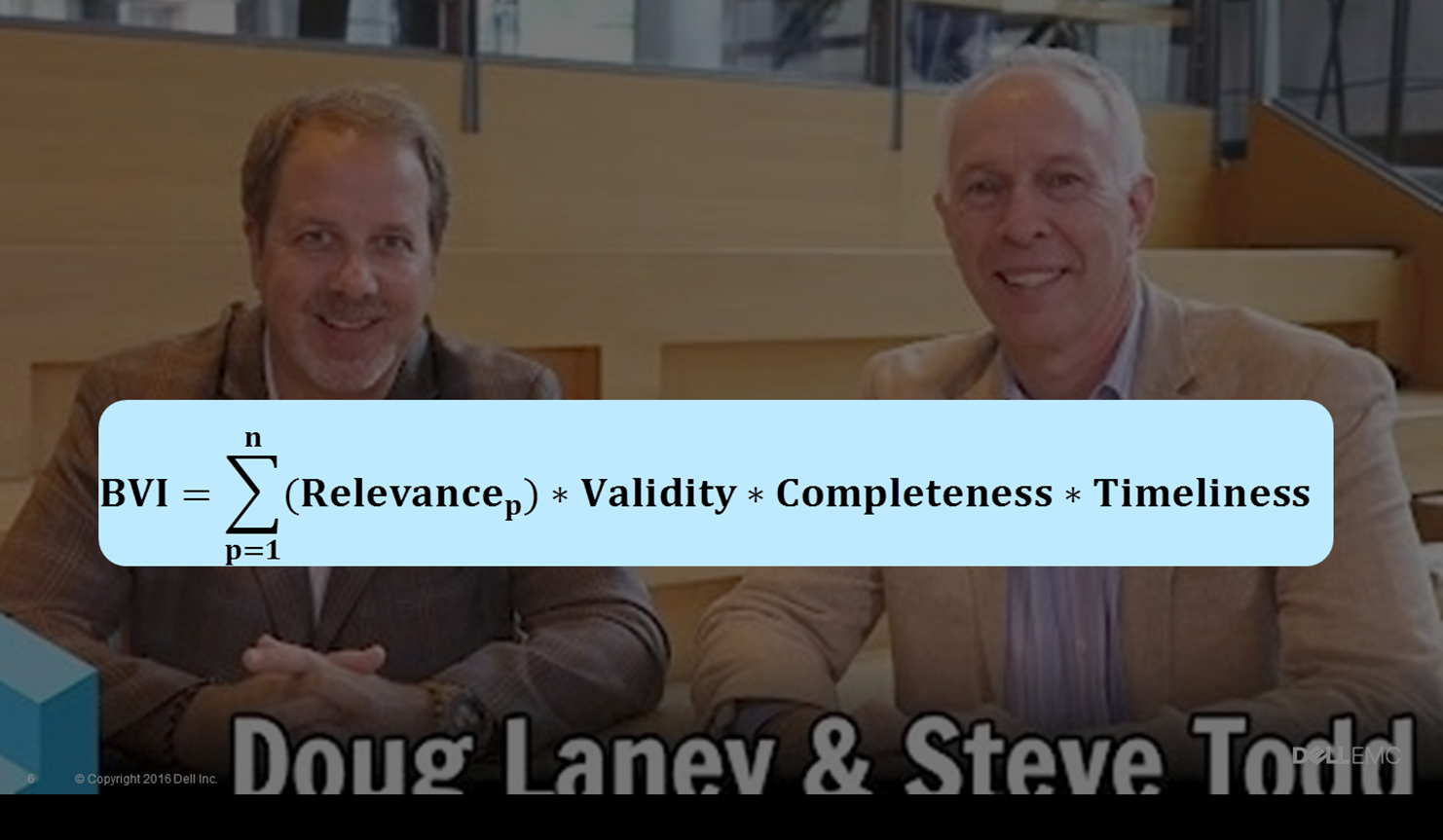
Similarly, Doug Laney has been developing his Infonomics approach to data valuation and has generated a set of equations that CIOs can use as a baseline method for conducting a discussion on data value. During my presentation I listed one such equation on the slide below.
Doug shared many of his thoughts on Infonomics here.
CIOs can take the research by Jim, combine it with learnings from industry experts like Bill and Doug, and use it to drive initial conversations about the value of data. Building a fluency in the discussion about data’s value is the first and most critical step. Each organization will have different algorithms for calculating data’s value. Once the CIO drives agreement on which algorithms are most important within their organization, they can move on to tackle the next most important insight.
Where should these algorithms run?
There are two key touch points within an IT architecture for implementing valuation. I will share these touch points in Insight 2 of 5.
Steve
Fellow, Dell Technologies