
In a recent post I introduced the importance of considering a “seamless” strategy when creating inter-cloud architectures. As part of that post I introduced a set of relevant technologies that apply to moving workloads and data between cloud deployments.
The first of these technologies was CloudLink. I emphasized CloudLink as a foundational security approach for enterprise accounts that are moving or placing specific application workloads and data into a public cloud environment.
In this particular post I’d like to focus on another use case: data protection. There is a growing trend in the industry in which on-premise backup infrastructure and processes are being replaced by off-premise implementations.
For this particular use case there is an EMC solution: CloudBoost. This technology has its origin in EMC’s acquisition of Maginatics. The underlying technology developed at Maginatics was a file system called MagFS. The MagFS technology was created as a client / server distributed file system that comes in handy as a cloud storage platform for data protection. CloudBoost’s underlying technology is certainly useful for other use cases but for this post I will focus solely on data protection.
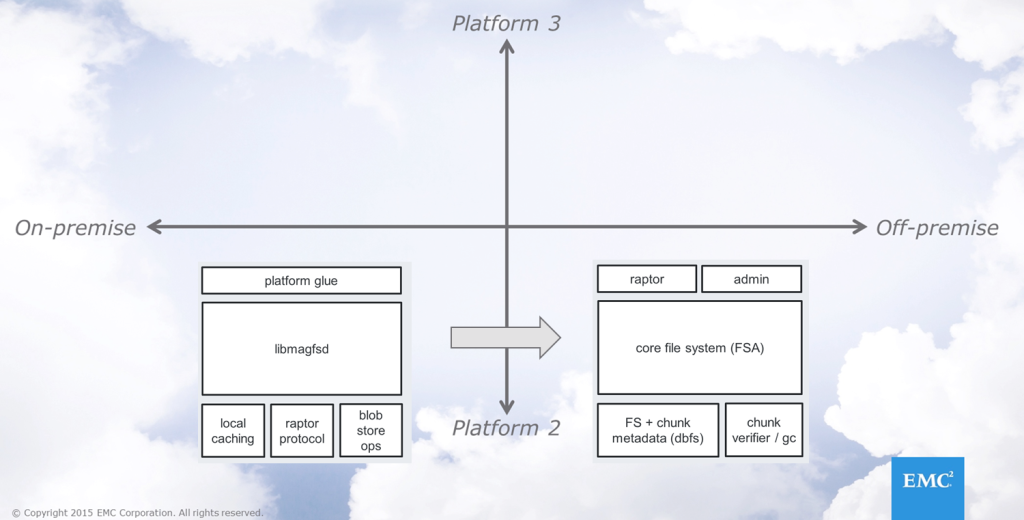
I have placed the client / server architecture of CloudBoost on the two quadrants below. I have focused on Platform 2 applications in which the enterprise pushes data protection infrastructure and processes to a cloud provider. This minimizes the data protection footprint and investment of the lower left-hand quadrants. On the left-hand side a file system interface (labeled as “platform glue”) is the gateway interface to the cloud.
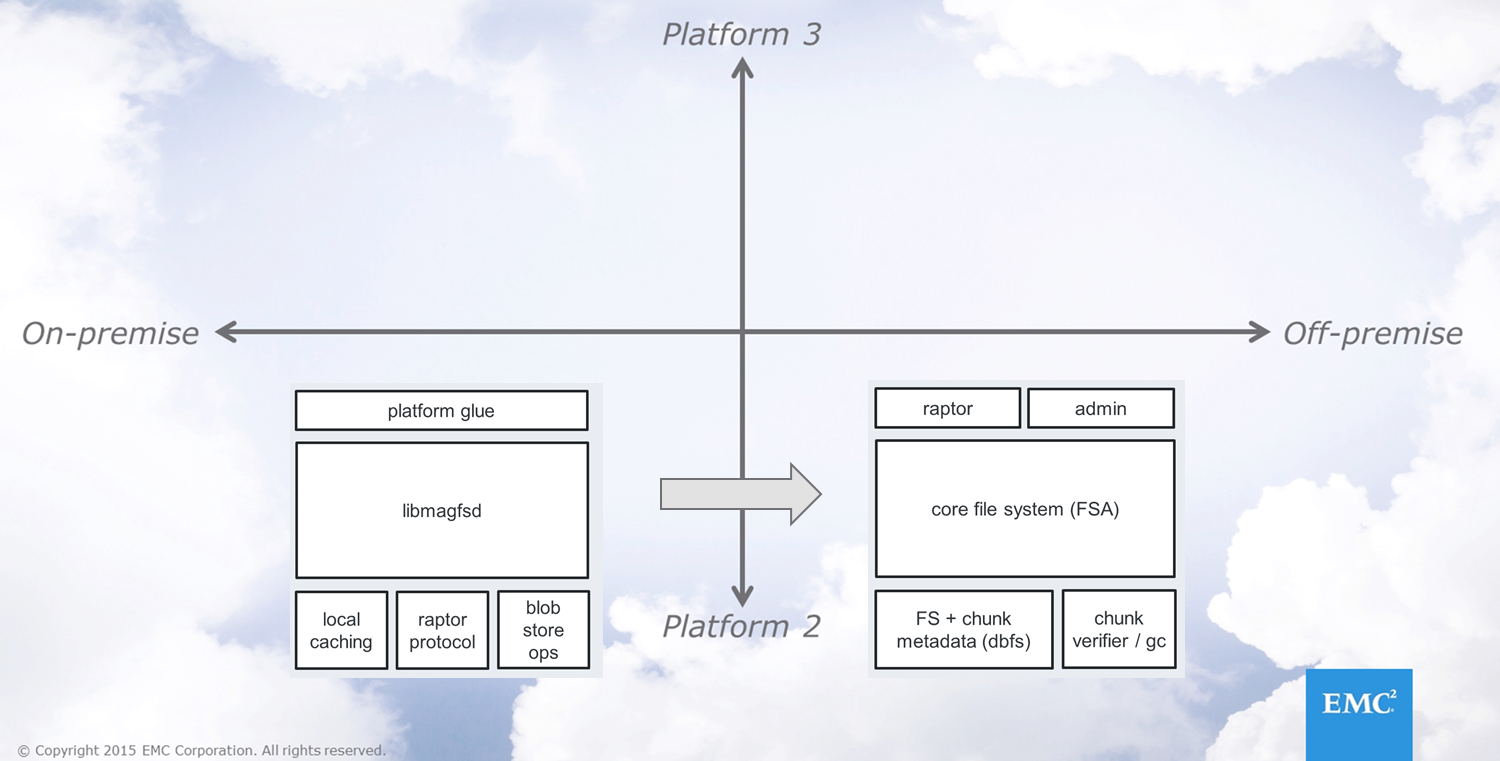
The diagram above hints at the overall functionality provided by CloudBoost. In general it is a file system interface that assumes that it is fronting a WAN and therefore implements significant caching and WAN acceleration capabilities. In addition, it assumes that the final resting place on the other side of the WAN is an object store.
I asked EMC Distinguished Engineer Vladimir Mandic to describe, at a high level, some of the main features provided by the CloudBoost platform. The following list gives a brief summary:
- WAN acceleration: efficient usage of high-latency links (multiplexing, out-of-order delivery, etc.)
- Encryption: strong end-to-end (over-the-wire and at-rest) encryption
- Deduplication: cloud-friendly variable block deduplication.
- Site cache: allows for fast RPO/RTO without reliance on remote copy.
The beauty of this architecture is the fact that a significant number of on-premise data protection solutions leverage a “local” file system as the data protection target. CloudBoost looks and acts like a local file system but has cloud storage capabilities on the back-end (not to mention the caching, WAN acceleration, dedup, encryption, etc). So enterprise accounts that have any of the following on-premise data protection technologies can leverage the CloudBoost interface to effectively move their data protection infrastructure off-premise:
- Networker
- Avamar
- Recoverpoint
In future posts I’d like to look a bit deeper under the hood of CloudBoost to understand some of the following characteristics:
- What are the APIs to control CloudBoost settings and parameters?
- How is the namespace managed?
- Can the technology be leveraged for “born in the cloud” apps?
- How well can it scale out?
- What is the relationship to cloud-based protection technologies like Mozy and Spanning?
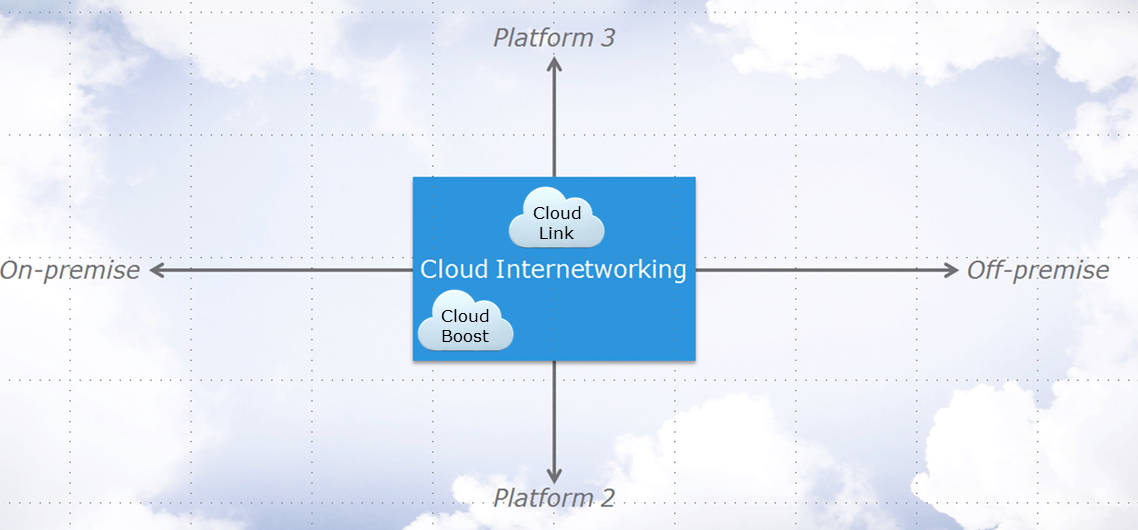
I will look at these and other attributes in this continued look at relevant cloud internetworking technologies:
Steve
EMC Fellow