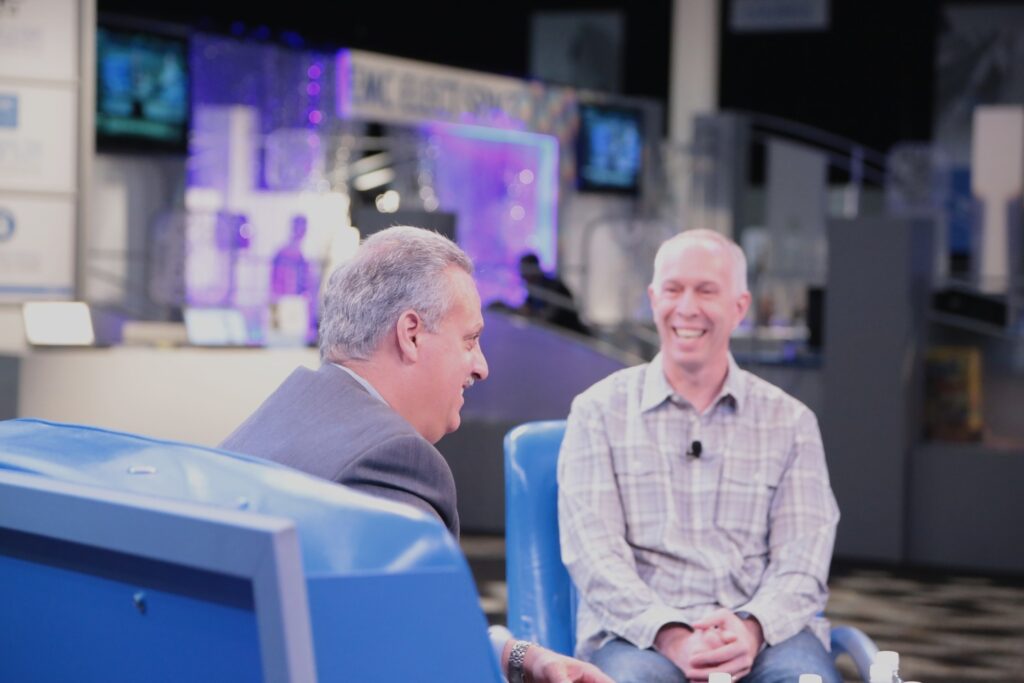

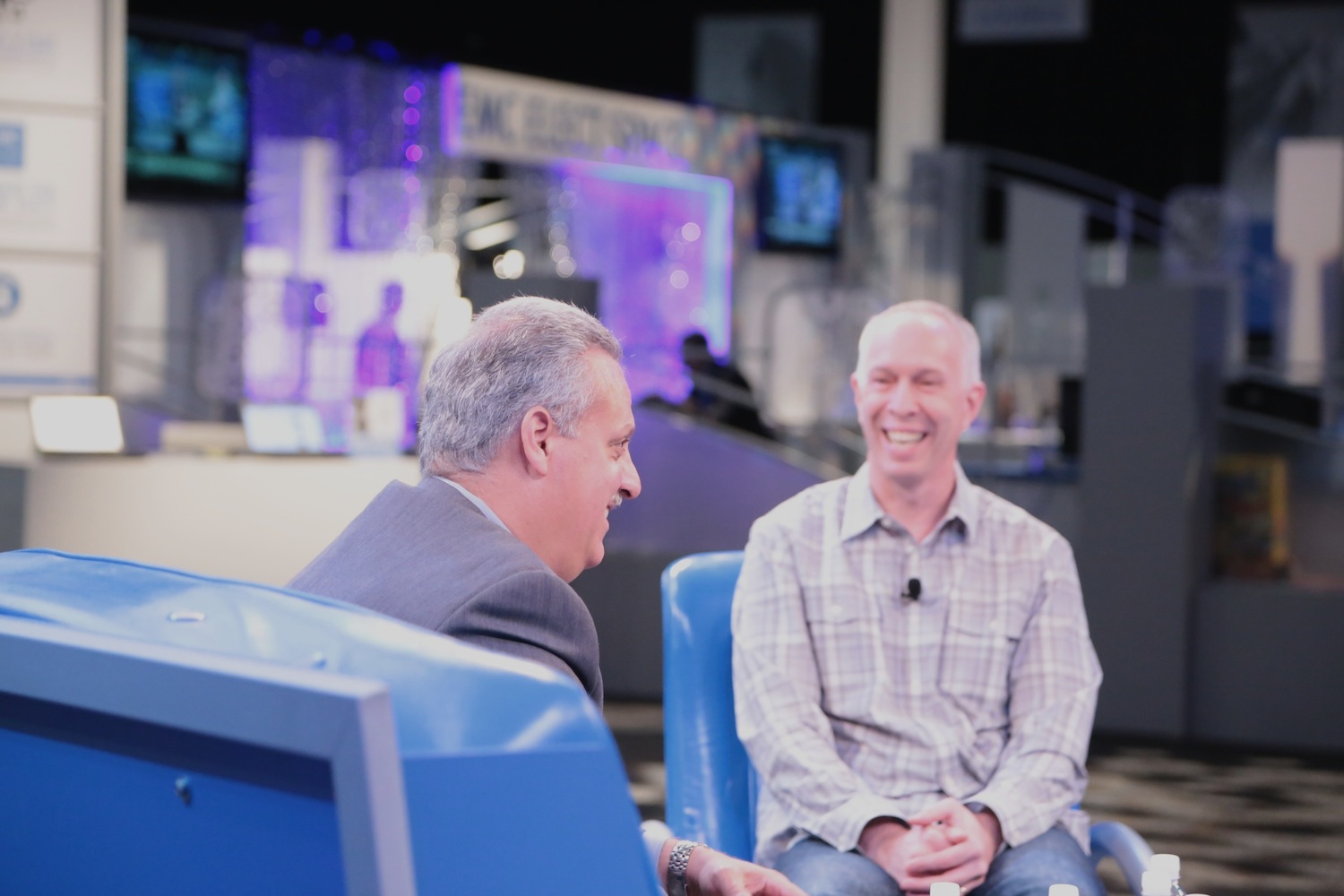
As usual my old VP Rich Napolitano had me laughing on Wednesday as I sat down with him for EMC Backstage. The appearance by Rich allowed EMC World attendees (physical or virtual) to tweet Rich their questions in response to his keynote.
Rich stressed VNX’s software assets quite a bit, and during his keynote he actually brought up three engineers from his research lab to demonstrate some (unreleased and work-in-progress) research areas:
- An exploration of VNX perofrmance maximums via an all-flash, screaming I/O performance platform featuring the up-and-coming MCX, multi-core functionality.
- An app-store capability where anti-virus and replication software were downloaded from a storefront interface to run directly within the VNX itself.
- The ability to run VNX entirely within a virtual machine. One demo showed a file being copied into a virtualized version of VNX, while a separate demo feature VNX as a VM being uploaded to a public cloud provider (Verizon).
One of the nice things about the Backstage session is that it allows the audience to ask Rich for a drill-down into any topic of their choosing. One of the best questions focused on asking Rich how customer input drives innovation. One of the key customer inputs is always “Make VNX Faster”. Rich explained that while the VNX “Flash-first” strategy has accelerated response times for many workloads, the multi-core MCX innovation obliterates the existing “knee in the curve” I/O saturation levels and starts to exhibit ridiculous I/O per second rates.
Other customer requests have led the VNX team to research the download of applications from a “storefront paradigm” directly into the VNX system. Virus scanners and replication software were two areas which were highlighted during the demo. The download of value-add applications to run inside VNX is another common customer request. Rich stated during our Backstage session that “he can’t count how many times” customers have asked for this feature. The research offers the possibility that customers will no longer have to acquire the hardware/software for a CAVA-style appliance, and could experience more of an “IT-as-a-service” experience for new apps.
One customer tweeted a question about how to decide between “all-flash” and “hybrid-flash” arrays. Rich answered by recommending a deep look at the workload in question. At first glance an all-flash aproach may be more expensive, but if deduplication ratios are taken into account the savings could be significant and all-flash may be the most cost-effective, performant way to go.
This conversation led us into a deeper look at workloads. David Goulden and Jeremy Goulden spoke quite a bit this week about the wide variety of customer workloads that our entire portfolio addresses. For VNX-appropriate workloads, however, Rich pointed out that tenant workloads vary wildly in the peaks and valleys of VNX resource consumption over time. This phenomena, Rich pointed out, is an interesting computer science problem that his team plans on solving with more effectively balancing VNX job scheduling to use the power of all the cores.
I closed out this session by commenting that EMC World is first and foremost a technology conference, and Rich delivered with a great keynote and engaging backstage session.
Steve
Twitter: @SteveTodd
EMC Fellow