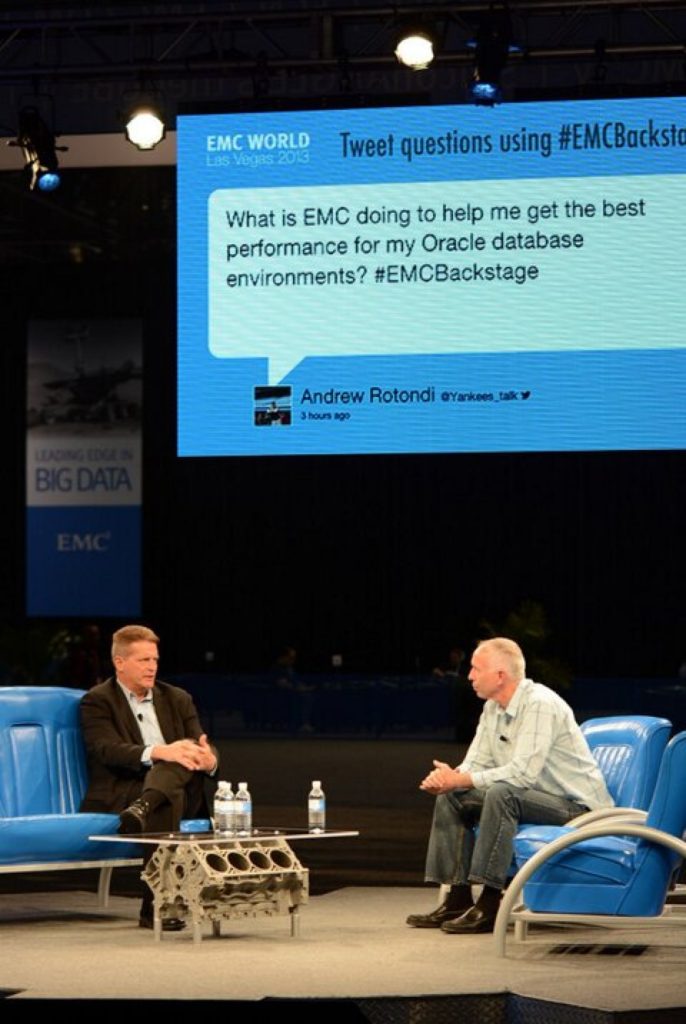

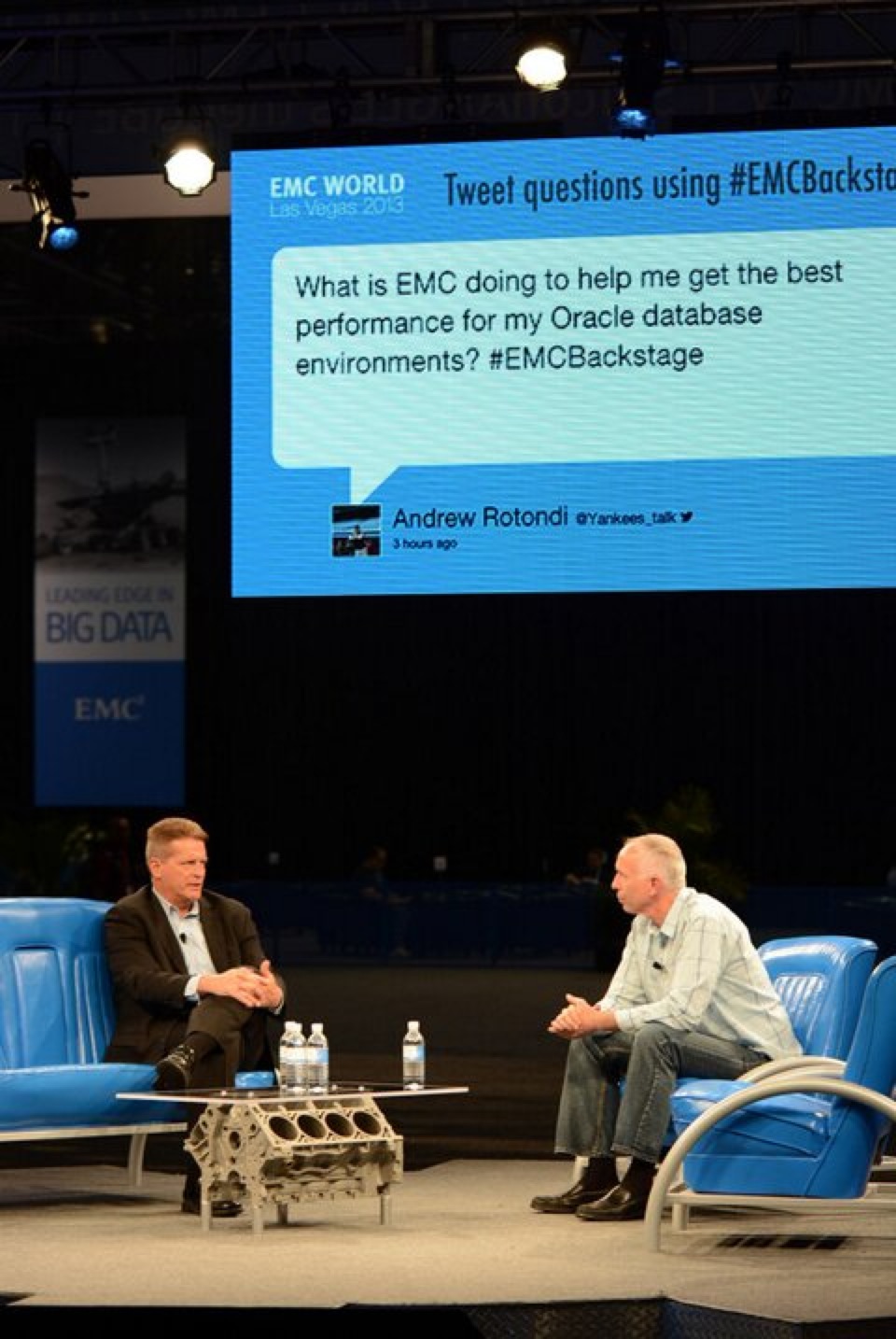
Photo by Sean Thulin
On Monday at EMC World I had a conversation with Brian Gallagher at the inaugural session of EMC Backstage. We took some live questions (Tweets) from
the crowd, and Brian was able to follow up on his keynote speech with some
great insights. I’d thought I’d share a few of them below.
Cloud in the Real World
During Brian’s keynote, he displayed several videos to the
audience that showed real-world customers deploying EMC cloud solutions with
“enterprise-class” data integrity, performance, business continuity,
disaster recovery, etc. In other words, three years after the
“journey to the cloud” began, customers are successfully running cloud-style
IT-as-a-Service offerings using the product set in Brian’s Enterprise Storage
Division. Service providers are building real-world, enterprise-class public
clouds. One of the key enablers, of course, has been the introduction
of VMAX Cloud Edition.
In fact, Brian pointed out that not only are Service Providers
meeting their ITaaS goals with VMAX Cloud Edition, but there is strong demand
for Cloud Edition from Enterprise customers as well.
Sideways
FAST (Fully Automated Storage Tiering) is going “Outside the
Box”!
Most people understand FAST to tier customer data vertically
between different layers of flash and disk drives. Brian described how
these algorithms will evolve to also automatically move data horizontally to
primary (e.g. a replica), secondary (e.g. Data Domain backup) and tertiary
(e.g. public cloud) targets. And like any good computer scientist
familiar with zero-based counting, Brian introduced the term
“zero-ary” to eventually enable horizontal integration of FAST
with all-FLASH disk array targets.
Why is this important? Because most customers will
introduce all-FLASH arrays as an adjacent technology to their existing data
centers. They will likely do this for specific workloads that require consistent low latency and high
IOPS. Zero-ary integration between VMAX FAST algorithms and all-FLASH systems
is a big win for customers that want to leverage their existing infrastructure
as they introduce flash technology.
VMAX Gravitational Pull
Brian’s keynote also described a unique VMAX future state:
software features that will soon be able to run inside the
system. This will allow software to run much closer to the data itself. Over time,
a wide variety of virtual machines, including
appropriate customer applications, will have the ability to run inside VMAX (as Brian
demonstrated during his keynote by running virtualized VPLEX inside).
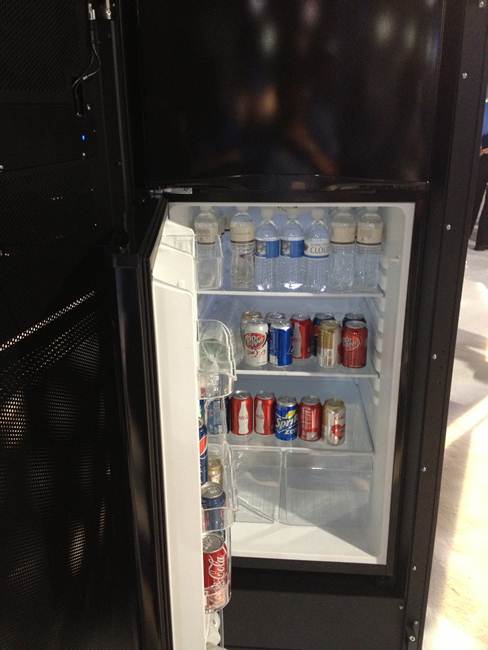 The EMC Backstage concept really allowed Brian to dive down into areas that EMC World attendees (physical or virtual) cared to hear more detail about. Brian and I also had a good laugh about the vFridge technology. During his keynote he had paused to grab an ice-cold water out of a fully functionally VMAX refrigerator. Some lucky EMC World attendee will bring that fridge home for their own personal use!
One final point raised by Brian is that this trend towards
software agility and mobility is the reason why VMAX integrates so well into
EMC’s new Software-Defined Storage strategy: ViPR.
This was the first EMC Backstage session of the week, and the
ability for EMC World attendees to Tweet questions directly to Brian made it an
engaging session.
Time permitting I’ll post the summaries with other EMC
Executives in the days to come!
Steve
Twitter: @SteveTodd
EMC Fellow