
On Tuesday I crossed the street and listened to Joe Tucci and team cover the EMC Q4 ’09 results. Mixed in with the financial overview was a reminder that the virtual desktop infrastructure is a key focus for 2010. I’ve watched this market grow (e.g. Chuck’s VDI posts over the last two years) and have seen quite a bit of material outlining the VMware and RSA architecture for VDI.
On the following day I was browsing through EMC ONE and noticed that Kris Cornwall had published a description of how customers are deploying EFDs and storage tiers to implement their own efficient VDI implementations. I follow Kris on Twitter (@KrisCornwall) and her tech stuff is good reading. In this case she had posted a customer summary written by one of her co-workers. I thought I’d summarize it here. For me it crystallized an important use case for EFDs as well as the value of having multiple tiers to choose from.
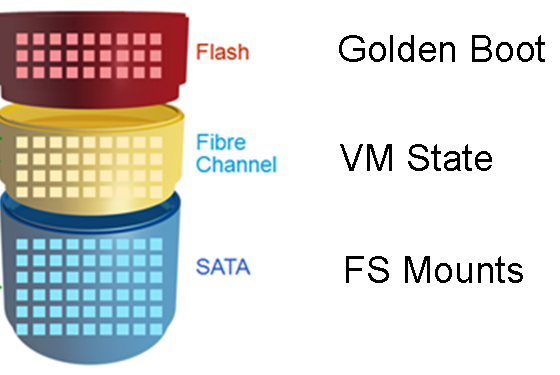
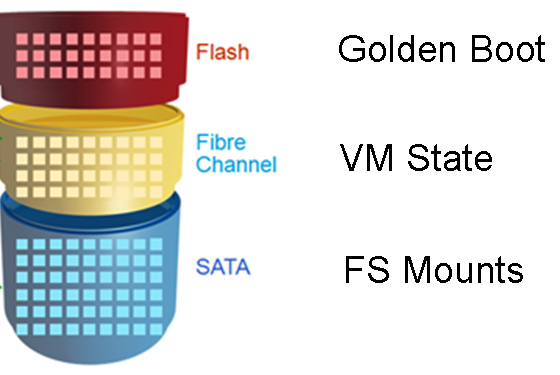
I’ve taken EMC’s FAST (fully automated storage tiering) diagram and pasted it below. I cropped out the arrows that indicate automated movement between tiers (the use case I’ll describe can be implemented with or without automated tiering). Next to each tier I’ve added a few words that describe how certain customers are leveraging each tier in their VDI implementations.
Golden Boot on the Flash Tier
Customers are configuring their enterprise flash drives to store the “golden boot” images for clients that are logging in to the virtual desktop infrastructure. Only a small amount of flash is necessary for environments where most clients have the exact same desktop interface. The small amount of flash, however, provides a big bang for the buck when it comes to servicing the “boot storms” that occur when hundreds of users arrive at work and begin logging on to their own virtual machines.
VM State on the FC Tier
Once the user has logged on, the operating state of each customer VM is kept on fast Fiber Channel drives. The capacity needs of this tier are greater than the amount required for flash. For several hundred users the flash tier will require gigabyte capacity, while the FC tier will typically reach into the terabyte range. As ESX servers utilize the FC tier, for example, they experience sufficient response times for operational management of VM instances (and therefore so do the users of each instance).
FS State on the SATA Tier
The final piece of the puzzle is the unique, persistent information that is associated with each user’s virtual machine instance. For this type of workload SATA drives are exported as file system mounts (using protocols such as CIFS). The workload for each user will vary, but the SATA tier satisfies the needs of the average user. Users consuming SATA mounts are limited to SATA speeds if their config was deployed before auto-tiering; the more recent FAST releases remove that restriction.
The article ended by pointing towards Celerra as the platform that provides both the block (EFD/FC) and file (CIFS/NFS over SATA) capabilities that can implement this type of VDI solution.
Kudos to the author of the article and kudos to Kris for posting it internally!
Steve
http://stevetodd.typepad.com
Twitter: @SteveTodd
EMC Intrapreneur