
The first set of speakers at the World Innovation Forum this morning focused on leadership and strong teams. It was engaging and interesting. We walked out into the New York sunshine for lunch and strolled back into Radio City Music Hall about 1:45 PM. I was wondering when we were going to hear about the state of the economy.
Starting at 2PM we got a double dose of the cold, hard facts about the financial crisis. Several of the bloggers joked about hurling themselves off the third floor mezzanine after hearing such bad news!
It was a double-dose of economic reality from two speakers: David Rubenstein and Jeffrey Sachs.
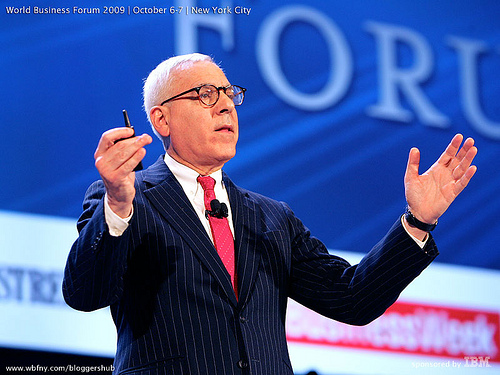
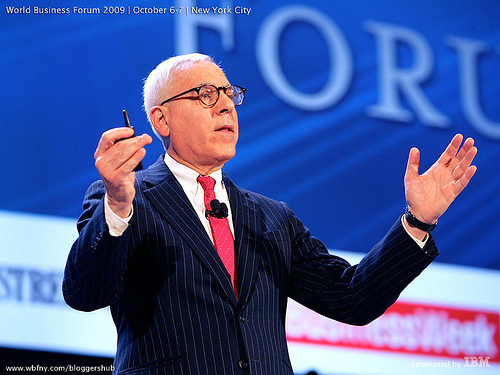
David Rubenstien at the World Business Forum
David Rubenstein's speech consisted of 30 minutes of painful economic data (it was an absolute blur of bad news). I stopped taking notes for fear of carpal tunnel. He ended, however, with some hopeful advice for how to go about living in this new reality:
- take risks
- improve your skills of persuasion
- stay out of debt
- join with partners who you trust
- think like a leader
- don't worry about making money in the longer term
- if you love what you do, money will flow.
- Regard your business activity as pleasure.
- If you don't love what you do, do something else.
- Involve yourself with China, India and Brazil.
- Be involved with your community
The upbeat ending was a temporary phase as Jeffrey Sachs took the stage and painted an extremely stark picture of the financial crisis and outlined the resulting new world order.
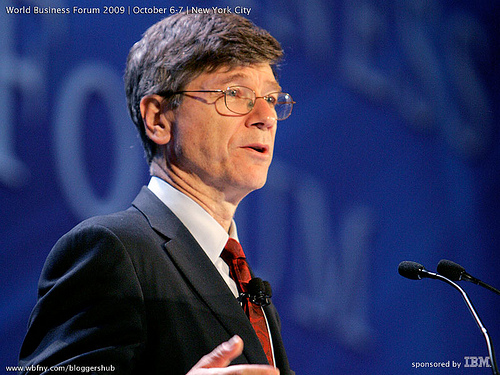
Jeffrey Sachs at the World Business Forum
Sachs called the financial crisis a "Wall Street crisis", as opposed to a US or a World crisis. "Easy credit" was de-regulated under the watch of Presidents Clinton and Bush. Sachs stated that the financial regulations put in place under FDR after 1929-1933 were systematically dismantled by the US government via the efforts of financial lobbyists (estimated to have spent 3.7 billion dollars lobbying). Foreign nations that modeled their markets after Wall Street found themselves in a similar situation, resulting in a global problem.
The financial problems are not easy to solve, because Sachs believes there are three very difficult and complex situations occurring at the same time:
- The world population is bursting at the seams. Simple mathematics show that there are not enough resources to consume. The lack of water will present an economic impact (as well as a health impact). Economic planning is not consistent with the nature of the bursting world problem. There's not enough land for crops and feed grain. The countries that are growing are ready to enjoy the "good times" that the US has enjoyed for years; this will likely result in ecological damage.
- There has been a fundamental readjustment of global politics. The sense of US predominance is fading. Sachs stopped short of comparing it to the "fall of Rome", but he did say the gap in income level and technological development is rapidly closing. This is a one-way street. The financial crisis accelerated the closing of this gap; it may have happened eventually in 15-25 years. Now it is happening today.
- The US government of the last 25-30 years has been inefficient to say the least. Sachs cited governement efficiency on health care, physical infrastructure (bridges/roads), the inability to respond to crises (New Orleans/Katrina), and two wars that Sachs believed were poorly rolled out and executed, and one (Iraq) started for fictitious reasons.
Sachs commentary In a word: scathing.
What to do? Job #1 from Sachs point of view: we must have a basic change in financial politics. The debates on most issues are a sideshow. The real issues are getting decided behind the stage door, in back-rooms. Wall Street is still negotiating with the House, campaign contributions continue to roll in.
His job #2 is to recognize that the US must solve the problems as a member of a global community. The US can no longer call the shots, and must work closely with all nations on the scale and sustainability issues resulting from the skyrocketing population. The top country to work with is China. China is now the banker of the world.
Steve
http://stevetodd.typepad.com
Twitter: @SteveTodd
EMC Intrapreneur