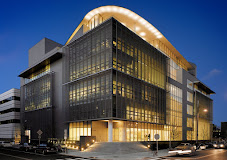

Yesterday I took a tour of the MIT Media Lab in Cambridge as part of EMC’s Innovation Network.
It was like a multi-level toy store for geeks (I fit right in). There were gadgets everywhere. I saw a video of a student waving his hands in front of a monitor in order to navigate through a series of rooms displayed on the screen. Shining a flashlight on the same monitor triggered CAM software to draw extensions of the flashlight’s rays onto the pixels of the same screen. The Bidi Screen is just one of the projects underway in the Information and Design Ecology department of the media lab.
I also learned some of the founding principles of the MIT Media Lab. Their track record when it comes to predicting the digital direction of our society is impressive. For example, one of the founders of the Media Lab, Nicholas Negroponte, predicted that everything that was wireless would become wired, and everything that was wired would become wireless. This prediction, known as the “Negroponte Switch”, has basically come to fruition (think telephones and televisions). There are many more examples of the Media Lab’s ability to predict and produce new digital trends.
New Deal on Data
Certainly when we heard the word “data” our ears perked up.
The mobility, aggregation, privacy, environmental context, social networking value, etc., of data are all areas of research and exploration at the Media Lab.
In particular, we are “carrying around” so much data in our pockets that the Media Lab has been exploring the use of an “amulet“, a device that is carried in your pocket for the purpose of gathering all of the wireless traffic that is going on around you in your particular geography. We watched a video of a researcher with an amulet and a projector on his head. When another student approached the researcher, the amulet picked up on that fact and the projector displayed the word “STUDENT” onto the approaching student’s chest!
The privacy issues with this type of data sharing are enormous. We met with Sandy Pentland, author of the book Honest Signals, and he shared the vision of a “New Deal on Data”, an informal privacy pact. After our meeting I found a great article that covers many of the issues Sandy shared with us during his talk.
The bottom line for the visitors was that it marked the beginnings of open collaboration and two-way flow of innovation between EMC and MIT. It’s a very, very open lab. It was clearly communicated that we can drop in any time and talk to professors and students (we were encouraged to challenge the students as well). Similarly, there will be a lot of MIT visits to EMC.
The afternoon was spent at Harvard University’s IIC (the Initiative for Innovative Computing). I plan to write a future post that will cover the challenges that researchers at Harvard are seeing as they process huge amounts of scientific data.
Steve
http://stevetodd.typepad.com
Twitter: @Steve Todd
EMC Intrapreneur