
One of the never-ending tasks when working at EMC is looking under the hood when it comes to new acquisitions and product announcements. It’s all about understanding how the software is architected and working. When I say “never-ending” I mean it in the best sense. There is always something new to learn.
So as I’ve attempted to peel back the layers of the VMWARE SpringSource acquisition I’ve been bumping into a set of terms and technologies that I’m not quite familiar with, starting with the StorageZilla post about CloudFoundry. When I logged onto CloudFoundry.com I saw the word “Beta” and knew that I had found something that I could sink my teeth into (similar to the Atmos Online beta).
I signed up for the beta, which should allow me to deploy a Java web application into the cloud. CloudFoundry gives me a few options here, and one of them is Grails. I’ve heard that Grails is dirt simple, so I figured I’d give it a try. Figuring out grails would help me figure out CloudFoundry, which would help figure out SpringSource, which would help me better understand why VMWARE bought SpringSource.
I wanted to build a Java web application called “FleaFlicker“, in honor of the upcoming (American) football season. After downloading grails from www.grails.org, I ran four commands:
grails create-app
grails create-domain-class
grails create-controller
grails run-app
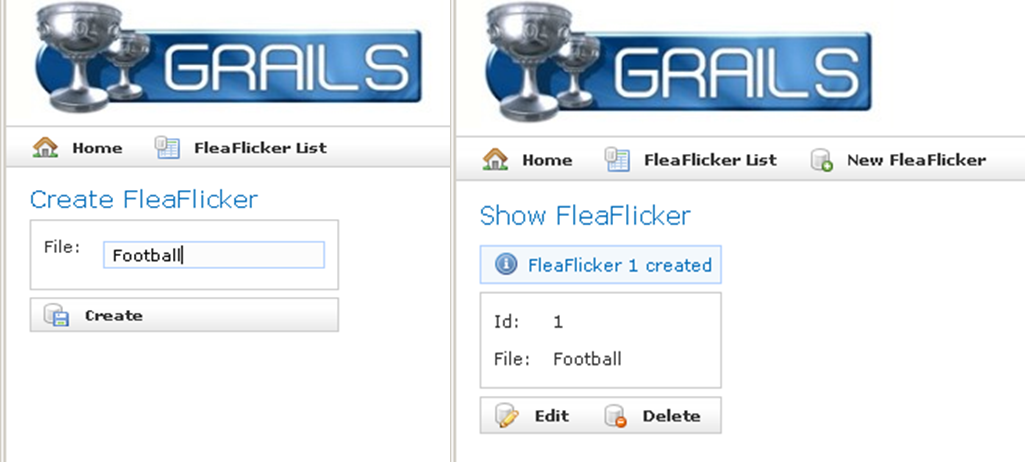
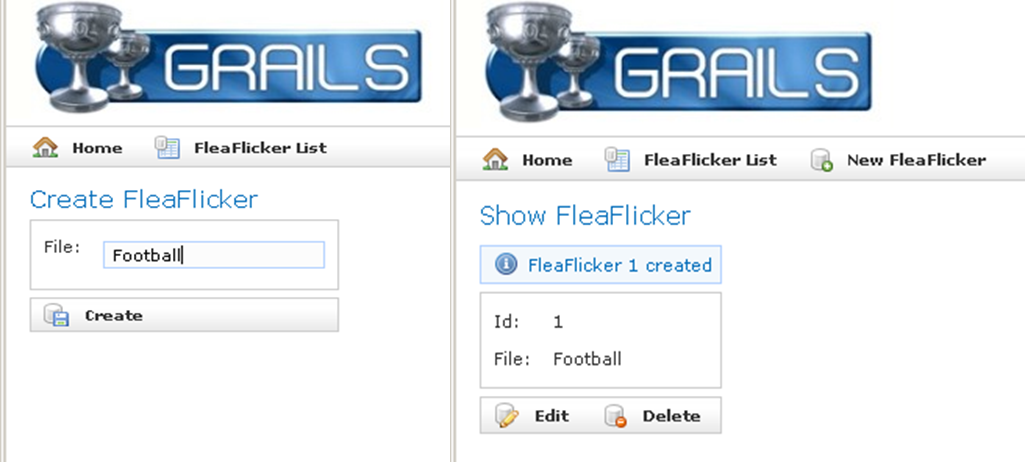
For each of these commands I gave some form of the name “FleaFlicker” as input. I also added the word “FleaFlicker” to a configuration file. When I used grails to run the FleaFlicker web application, I was able to instantly connect (via my browser) and display/create/destroy FleaFlicker objects. Here are two different screen shots appended together:
That was easy. I hadn’t written a stitch of Java code but I had already deployed a Java application (which I assume can be loaded into a compute cloud via CloudFoundry).
This leaves me with a web application framework that allows me to write some Java business logic. In order to run the ‘ole FleaFlicker play I need to toss some objects around. I’ve downloaded the Atmos Java Binding and plan to attempt the integration of Atmos, Grails, and hopefully CloudFoundry. More in a future post.
Steve
http://stevetodd.typepad.com
Twitter: @SteveTodd