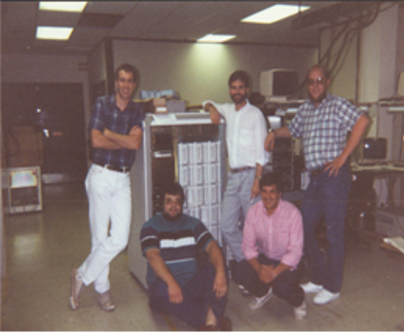

Happy Cinco De Mayo. I have to admit that until recently I was unaware of this Mexican holiday and the history behind it. My first introduction to Cinco De Mayo was probably a Corona beer commercial. Anyway the 5th of May has got me thinking about the very first “code name” for the product that would eventually become CLARiiON.
The Corona Project.
Launched in 1987 at the Data General facility in Durham, NH, the Corona Project faced one of its biggest obstacles in early 1990 when the powers-that-be at DG’s Westborough headquarters started asking themselves a question that had become a DG semi-annual tradition:
Should we lay these guys off?
The Corona Project
In 1987 Data General was planning on building a fault-tolerant computer called Lynx. Lynx would have two of everything. Two motherboards, two CPUs, two memory systems. Adjacent CPUs would execute the exact same instructions, and one CPU could run the show if the other one failed. The Lynx team began to ponder how to architect fault-tolerant storage, and they heard about RAID. Now RAID really wasn’t fault-tolerant; it was highly-available. That’s close enough. The real cool stuff would be Lynx.
At the time DG had opened a brand new Mass Storage facility just outside the campus of the University of New Hampshire. A huge manufacturing wing was built (it was never used). The office building was built in a beautiful setting in the middle of the woods. The smell of cows was everywhere. The idea for building a RAID storage array was given to the head of the facility. His name was Joe Godbout. This project was bigger than anything ever done in Mass Storage Engineering before, and he had been saving a special project code name for just such an occasion: Corona.
The general hardware architecture for Corona came together pretty quickly. Given the fault tolerant nature of Lynx, it was generally agreed that dual-storage processors would be needed for HA. It was also agreed that the dual SPs would run RAID algorithms on a shared set of back-end SCSI disks.
The software architecture took a little longer to put together, but fairly early on it was given a name: FLARE. Back then software efforts were given groovy names representing solar events (e.g. Sunburst, Blaze).
Goodbye Lynx, Goodbye Durham
The Lynx project was canceled. I don’t remember much about it. Remember when you’re just out of college and you don’t really pay attention to the big picture? Well, that’s where I was at. I recall that several of the fault-tolerance experts went to work at Stratus. Work on FLARE and CORONA was redirected towards hooking up to DG’s AViiON server line.
The economic situation in 1990 was grim. The Durham facility had been planned during DG’s boom years and completed just before the recession of the early 90s. There was always talk of “closing the doors up at Durham”. My first meeting ever at DG was a layoff meeting. DG went from over 18,000 employees in 1986 to roughly four to five thousand at the end of the 90s. When manufacturing operations in Durham never materialized they replaced the plant manager with a new “VP of Closing Doors” in 1990. An announcement that the Durham facility would be closing and layoffs were imminent came shortly thereafter.
The day of the layoff went like this: we were instructed to sit in our offices and wait for the phone to ring. If you answered your phone and were asked to walk down to HR, you were laid off. My wife called me to ask me what was going on. I told her that I would appreciate it if she didn’t call my office for the rest of the day. ;>) My former roommate worked with me at DG and he wondered if they could lay him off if he wasn’t at his desk to answer the phone. While he was talking to me they paged him over the intercom system. His strategy didn’t work.
The FLARE team lost some members that day, but since you know the end of the story (CLARiiON) I can tell you that some of us got relocation packages to move down to the Westborough, MA facility.
Why didn’t we all get laid off? Well, this is where the legend begins. Rumor has it that the fate of the CORONA project was being discussed by a set of five vice-presidents in the office of the President of Data General, Ron Skates. It came down to laying off the FLARE team versus laying off engineers on DG’s text-based e-mail product, CEO (Comprehensive Electronic Office). Four out of the five VPs said: let’s get rid of the Corona project. As legend has it one of the VPs said: “Having a RAID device can help us sell some AViiONs”.
So we were spared (according to the legend).
HADA
We moved to Westborough and several months later we shipped the first RAID5 High Availability Disk array (running FLARE rev 2) in March of 1991. People thought it was amazing that we put handles on the disks and could yank them live right out of the array. The HADA was sold with AViiON servers and connected via a VMEbus interface. It had the 520-byte sectors and the data integrity and performance that I’ve been blogging about. (well, um, actually we had some “pre-write cache” performance issues, as you could imagine).
And yes it did help to sell some AViiONs.
Then some of the bright guys from Durham started asking the question: what if we replaced the VMEbus with a SCSI bus?
Wouldn’t that allow us to hook up to AViiON’s competitors? What would this mean for DG?
That’s a history lesson for another day.
Pero hoy es una fiesta. For a true history lesson, start reading here.
Steve
P.S. I’d love to head additional insight from anyone that was around during those times…..